
So I’m finally done with getting my ankle fixed.
I claimed $150,000 in hospital bills this year. Two surgeries, five hospital stays, various treatments.
My rider covered about $15,000 of it. That’s 10% of the total.
On paper, it looks small. MediShield Life covered about $80,000. My main plan covered about $55,000. The rider handled the deductible and reduced my co-insurance from 10% to 5%.
But here’s the thing: my rider still made sense for me. I’m young. My premiums are low—just over $1,000 per year. One major surgery every few years justifies that cost.
If I were 55 and paying $5,000 per year for that same rider? The math would look very different.
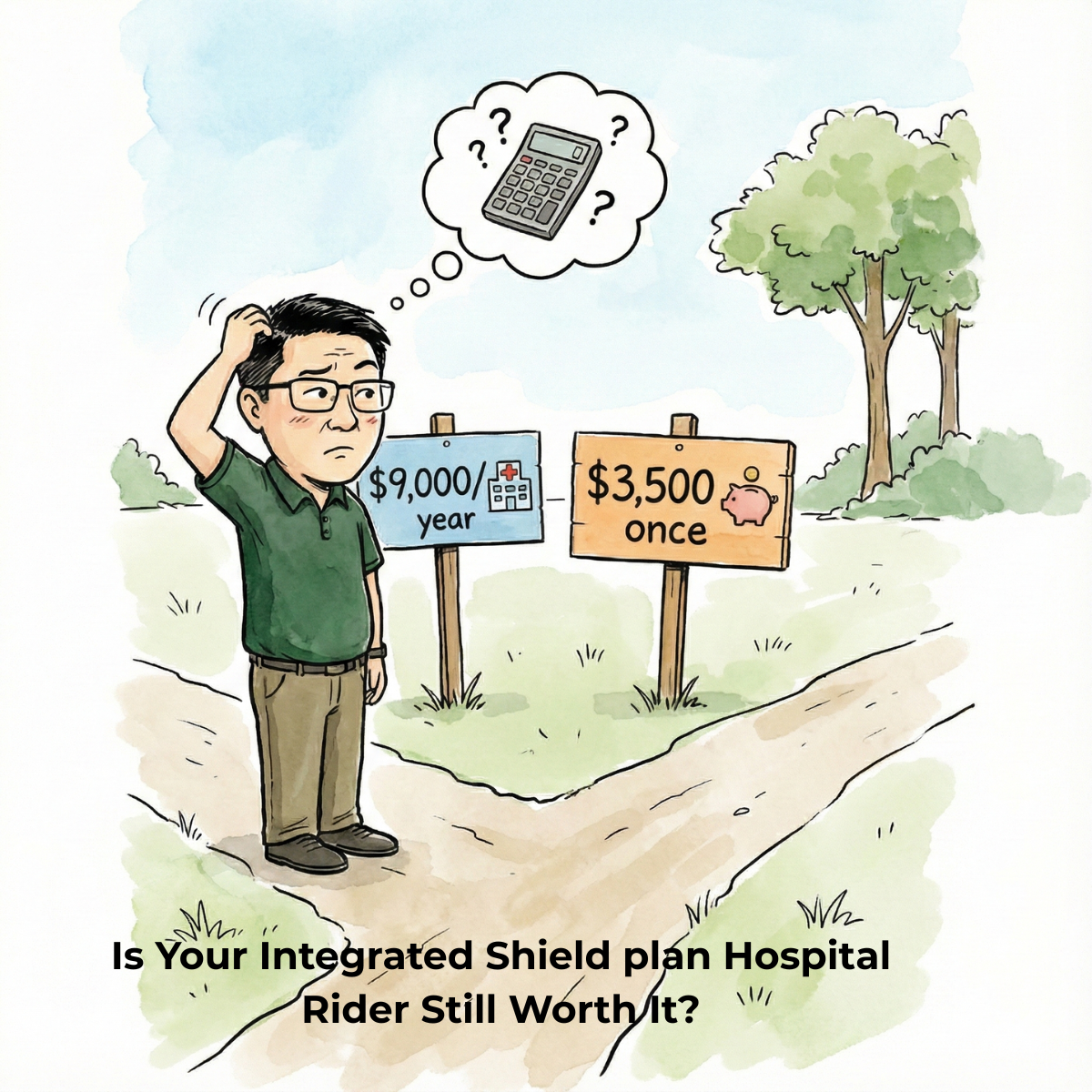
MOH is tightening the rider system in Singapore. Premiums are rising. Coverage is being capped. If you’re paying $4,000 to $9,000 per year for a rider, you’re probably wondering: is this still worth it?
The answer isn’t “yes” or “no.” It’s “it depends on your situation.”
This post will help you figure out whether your rider is worth keeping based on your age, health, and financial situation.
What MOH Is Doing (And Why It Matters)
MOH has been tightening regulations on Integrated Shield Plan riders for years. The latest moves focus on capping benefits and controlling premium increases.
Why? Because private hospital costs in Singapore have been rising faster than the system can sustain. Between 2019 and 2024, private hospital bills increased by an average of 8% to 10% per year. Riders, which reduce out-of-pocket costs to nearly zero, remove the incentive for patients to be cost-conscious. The result: overconsumption, higher claims, higher premiums.
MOH’s response: limit rider benefits, cap coverage, slow down premium growth.
What’s changing:
- Rider benefits are being capped at certain levels
- Premium increases are being regulated more tightly
- Some riders may no longer cover 100% of costs above the deductible
This doesn’t mean riders are going away. It means they’re becoming more expensive and less comprehensive than they used to be.
If you’re paying $4,000 to $9,000 per year for a rider, you’re already feeling the squeeze. The question is: what are you actually getting for that cost?
What Riders Actually Cover
Most people think riders cover “everything the main plan doesn’t.” That’s not quite right.
Here’s what a rider actually does.
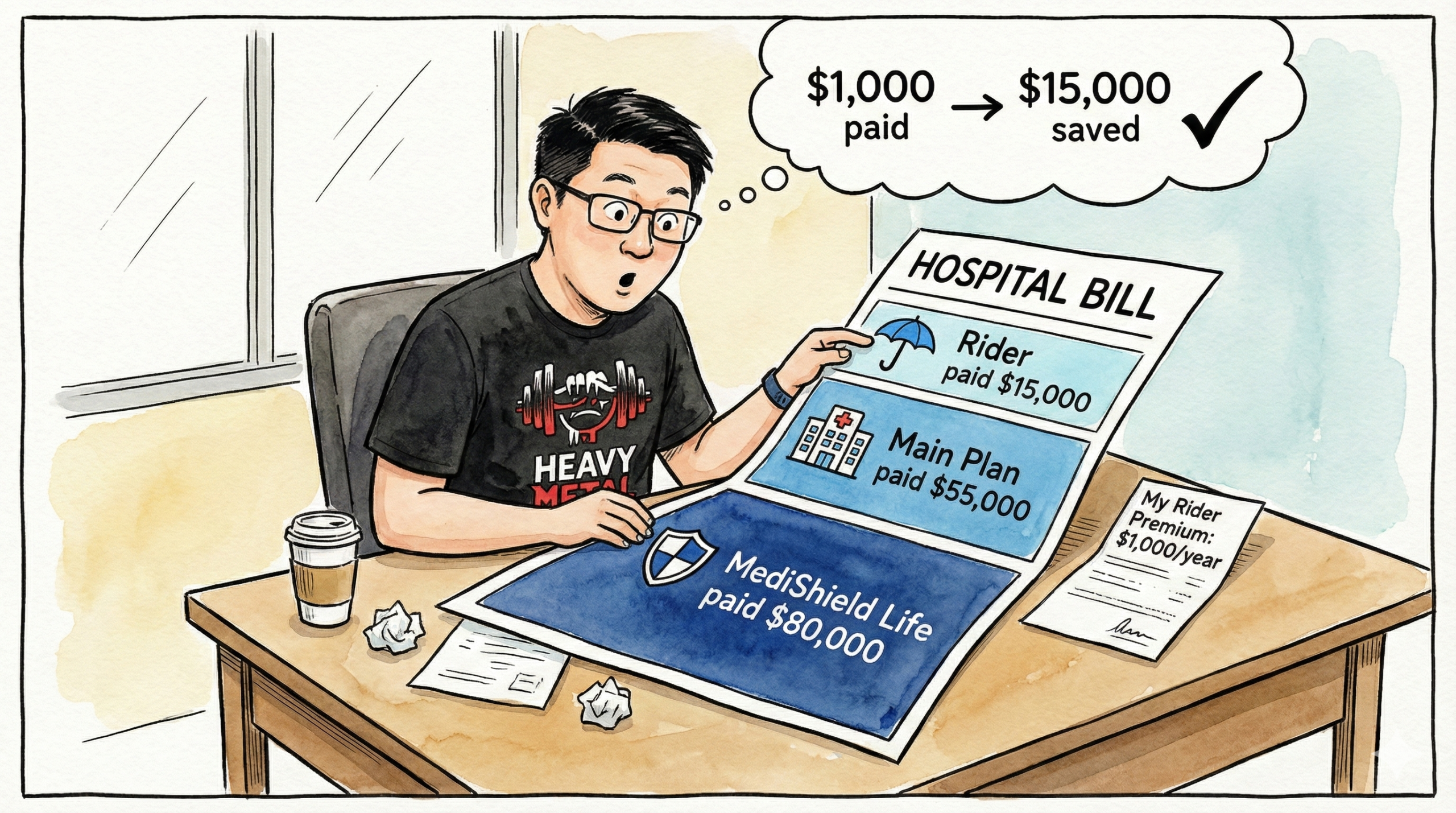
Riders cover the deductible. For private hospitals, the deductible is typically $3,500. Without a rider, you pay this out of pocket. With a rider, it’s covered.
Riders reduce co-insurance. Without a rider, you pay 10% of the hospital bill after the deductible. With a rider, you pay 5% (or sometimes 0%, depending on the rider type).
That’s it. The rider doesn’t give you faster hospital access. It doesn’t increase your coverage limits. It doesn’t change what the main plan covers. It just reduces your out-of-pocket costs.
Let me show you how this plays out with real numbers.
Say you need surgery. The bill is $100,000.
Without a rider (main plan only):
- You pay $3,500 deductible
- You pay 10% of the remaining $96,500, which is $9,650
- Total out of pocket: $13,150
With a rider:
- Rider covers the $3,500 deductible
- You pay 5% of the remaining $96,500, which is $4,825
- Total out of pocket: $4,825
The rider saves you $8,325 on a $100,000 bill.
Now here’s the question: how much are you paying per year for that rider?
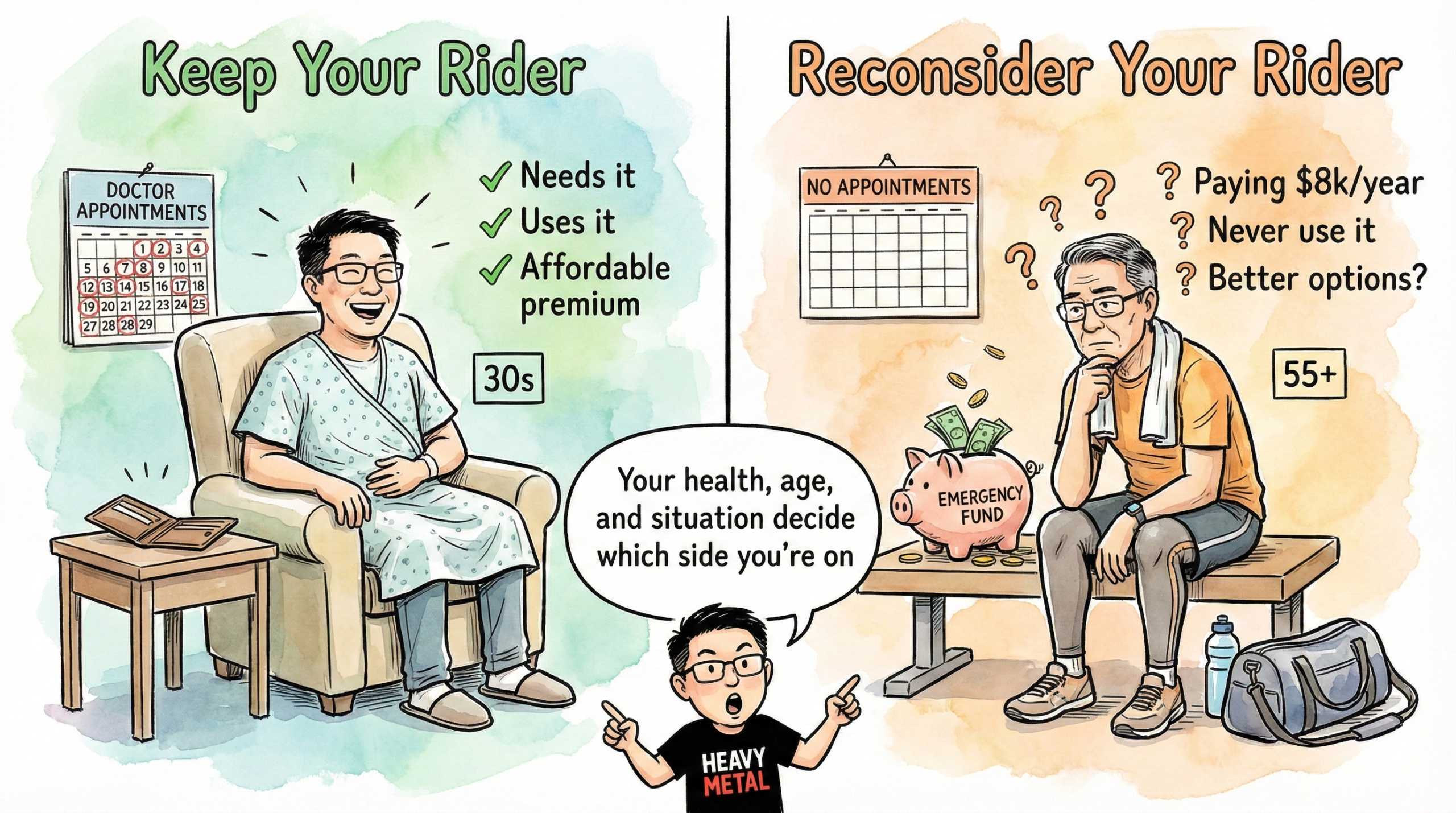
If you’re 30 years old, your rider might cost $800 to $1,200 per year. Over ten years, that’s $8,000 to $12,000. If you have one major surgery in that decade, the rider roughly breaks even or comes out ahead.
If you’re 50 years old, your rider might cost $4,000 to $6,000 per year. Over ten years, that’s $40,000 to $60,000. You’d need multiple major hospitalizations for the rider to pay for itself.
If you’re 60 years old, your rider might cost $7,000 to $9,000 per year. Over ten years, that’s $70,000 to $90,000. Unless you’re hospitalized frequently, you’re paying far more than you’ll ever claim back.
My $150,000 Claim: What Covered What
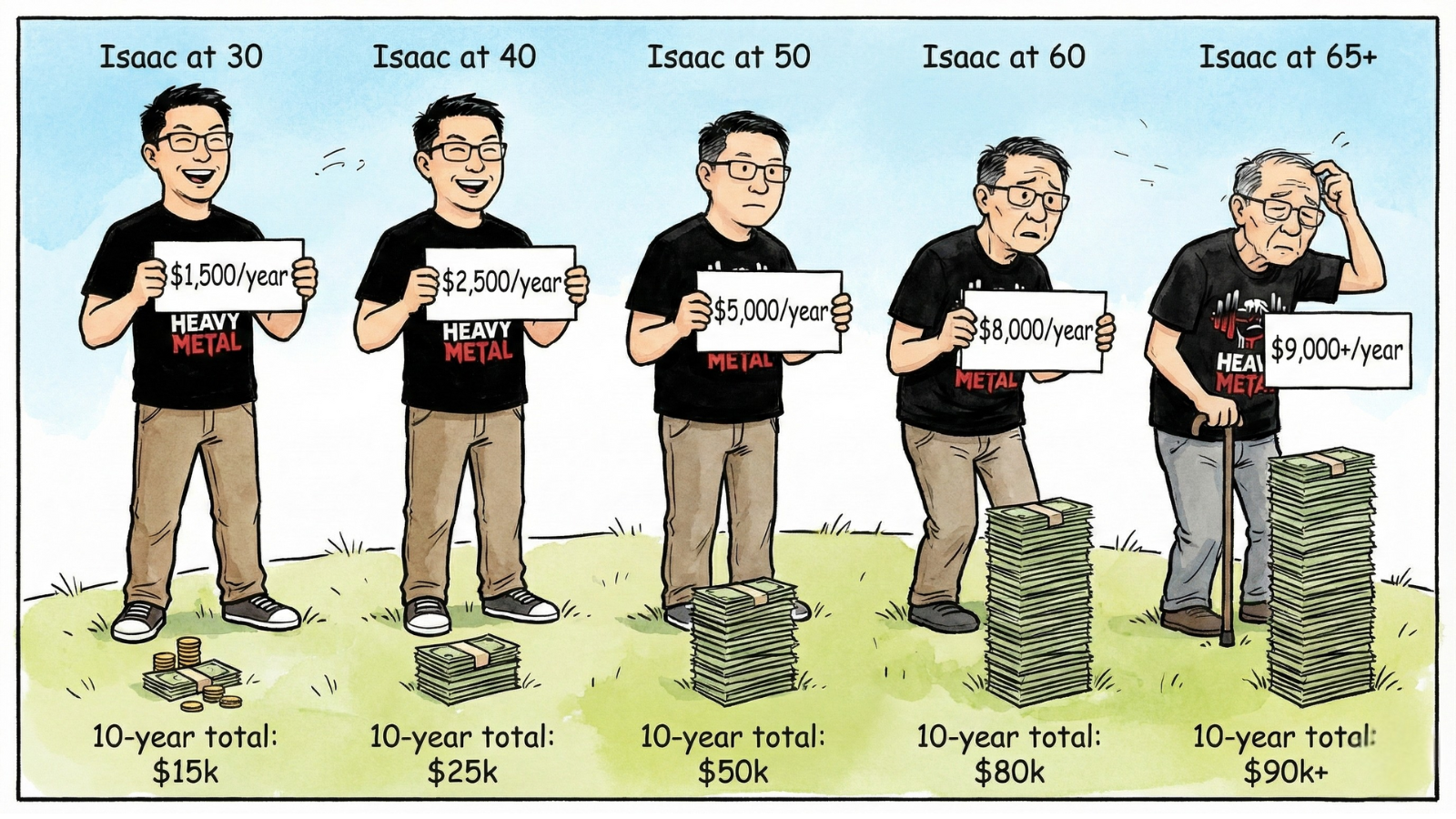
This year, I claimed about $150,000 in hospital bills. Two surgeries for a torn ATFL, five hospital stays, various treatments.
Here’s how the coverage broke down.
MediShield Life covered about $80,000. This is the government plan that everyone has. It’s the main workhorse for big hospital bills. Most people don’t realize how much MediShield Life actually covers because they assume their private plan is doing all the work. It’s not.
My main plan covered about $55,000. This is the Integrated Shield Plan from my insurer. It filled in the gaps that MediShield Life didn’t cover.
My rider covered about $15,000. This was the deductible plus the 5% co-insurance reduction.
I pay over $1,000 per year for that rider. This year, it covered $15,000, so it was absolutely worth it. But if I hadn’t been hospitalized, I’d have paid $1,000 for nothing.
Over the next ten years, if I stay healthy, I’ll pay $10,000 in rider premiums to avoid a $3,500 deductible and reduce co-insurance by 5% on bills I might not have.
For me, at my age and premium level, that’s still a reasonable trade-off. But the equation changes as you get older and premiums climb.
When Riders Are Worth Keeping
Riders aren’t useless. They serve a clear purpose. Here’s who benefits most from keeping a rider.
People in their 30s and 40s with low rider premiums ($1,000 to $2,000 per year). At this cost level, riders are relatively cheap insurance. One major surgery in your 30s or 40s can easily justify 5-10 years of premiums. The younger you are, the better the cost-benefit ratio.
People with chronic conditions requiring frequent hospital stays. If you’re in and out of hospitals every year—diabetes complications, heart conditions, ongoing treatments—the co-insurance savings add up fast. The 5% difference between main plan only and main plan plus rider becomes significant when you’re claiming annually.
For example: if you have three $30,000 hospital stays over five years, the rider saves you about $4,500 per stay, or $13,500 total. If your rider costs $2,000 per year, you’re paying $10,000 over five years to save $13,500. That’s a good deal.
People who can’t afford $3,500 to $5,000 out of pocket. If an unexpected hospital bill would strain your finances, the rider gives you predictability. You know your out-of-pocket costs will be minimal. That peace of mind has real value, especially if you don’t have a solid emergency fund.
People who prioritize financial predictability over cost efficiency. Some people are comfortable with variable costs. Others aren’t. If you’re someone who would rather pay a fixed premium every year than face a potential $10,000 hospital bill, even if the math suggests self-insuring is cheaper, the rider might be worth keeping for psychological reasons alone.
People approaching major medical events. If you’re planning surgery, know you have a condition that will require hospitalization soon, or are entering a higher-risk health phase, keeping your rider through that period makes sense. You can always reassess after.
When Riders Might Not Be Worth Keeping
Here’s who might be better off reconsidering their rider.
People over 50 paying $4,000 to $9,000 per year. At these premium levels, you’re paying $40,000 to $90,000 over ten years to avoid a $3,500 deductible and reduce co-insurance by 5%. Unless you expect frequent hospitalizations, the math doesn’t work. You’re essentially pre-paying for hospital bills you might never have.
Healthy people with strong emergency funds covering $5,000 to $10,000. If you can afford to pay $3,500 out of pocket without financial stress, and you’re comfortable absorbing 10% co-insurance on a major bill, you don’t need the rider to cover the deductible. Self-insure it with your emergency fund instead.
People who rarely use hospital services. If you’re healthy, active, and haven’t been hospitalized in years, you’re paying for coverage you’re not using. Every year without a claim is money that could have been redirected to critical illness coverage, disability income, or investments.
People comfortable with co-insurance risk. Ten percent of a $100,000 bill is $10,000. If you can handle that level of out-of-pocket cost in a worst-case scenario, the rider’s 5% reduction (saving you $5,000) might not justify $4,000 to $6,000 in annual premiums.
The key question: would you rather pay $5,000 per year guaranteed, or potentially pay $10,000 once every 5-10 years? For many people in good health, the latter makes more financial sense.
 How to Decide for Your Situation
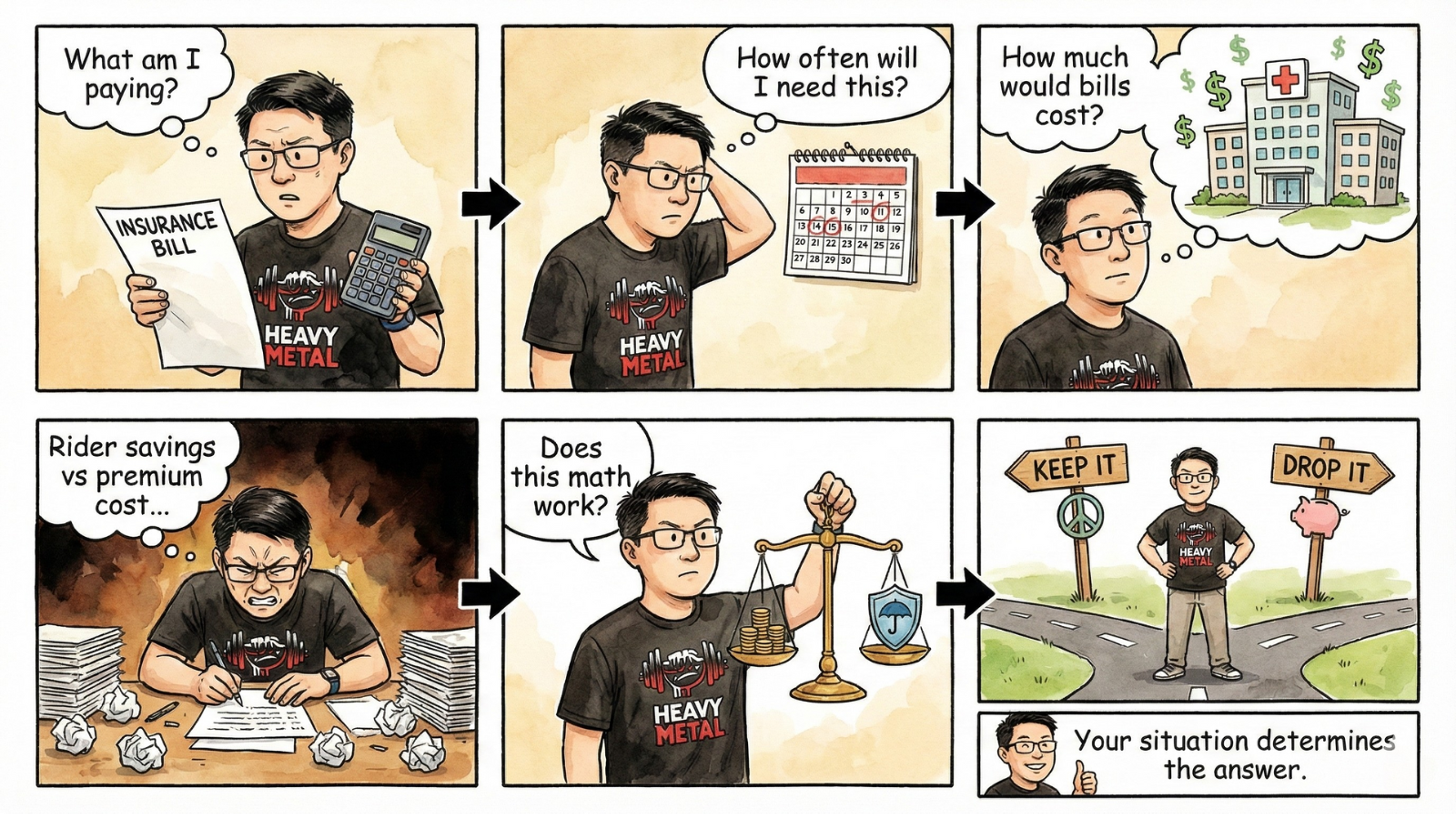
Here’s a step-by-step framework to evaluate whether your rider is worth keeping.
Step 1: Find Out Your Annual Rider Premium
Check your policy statement or call your insurer. Write down exactly how much you’re paying per year for the rider component (not the main plan).
Step 2: Estimate Your Hospital Usage Over the Next 10 Years
Be conservative. How many times do you realistically expect to be hospitalized in the next decade?
- Healthy, no chronic conditions: 0-2 times
- Occasional health issues, minor surgeries: 2-4 times
- Chronic conditions, regular treatments: 5+ times
Step 3: Estimate Your Hospital Bills
For each expected hospitalization, estimate the bill size:
- Minor procedures: $10,000 to $20,000
- Moderate surgeries: $30,000 to $60,000
- Major surgeries: $80,000 to $150,000+
Step 4: Calculate Expected Savings from Your Rider
For each expected bill:
- Rider saves you the $3,500 deductible
- Rider saves you 5% of the remaining bill
Example: $50,000 surgery
- Deductible saved: $3,500
- Co-insurance saved: 5% of $46,500 = $2,325
- Total saved per surgery: $5,825
Multiply by number of expected surgeries over 10 years.
Step 5: Compare Total Premiums vs Total Expected Savings
Total premiums over 10 years: (Annual rider premium) × 10
Total expected savings over 10 years: (Savings per surgery) × (Number of expected surgeries)
If premiums significantly exceed expected savings, the rider might not be worth it.
If expected savings exceed or roughly match premiums, the rider makes sense.
Step 6: Factor in Risk Tolerance and Liquidity
Even if the math says “drop the rider,” consider:
- Can you absorb a $3,500 deductible without stress?
- Can you handle 10% co-insurance on a $100,000 bill ($10,000 out of pocket)?
- Do you value predictability over cost efficiency?
If the answer to any of these is “no,” keeping the rider might still be worth it for peace of mind.
What to Do If You Drop Your Rider
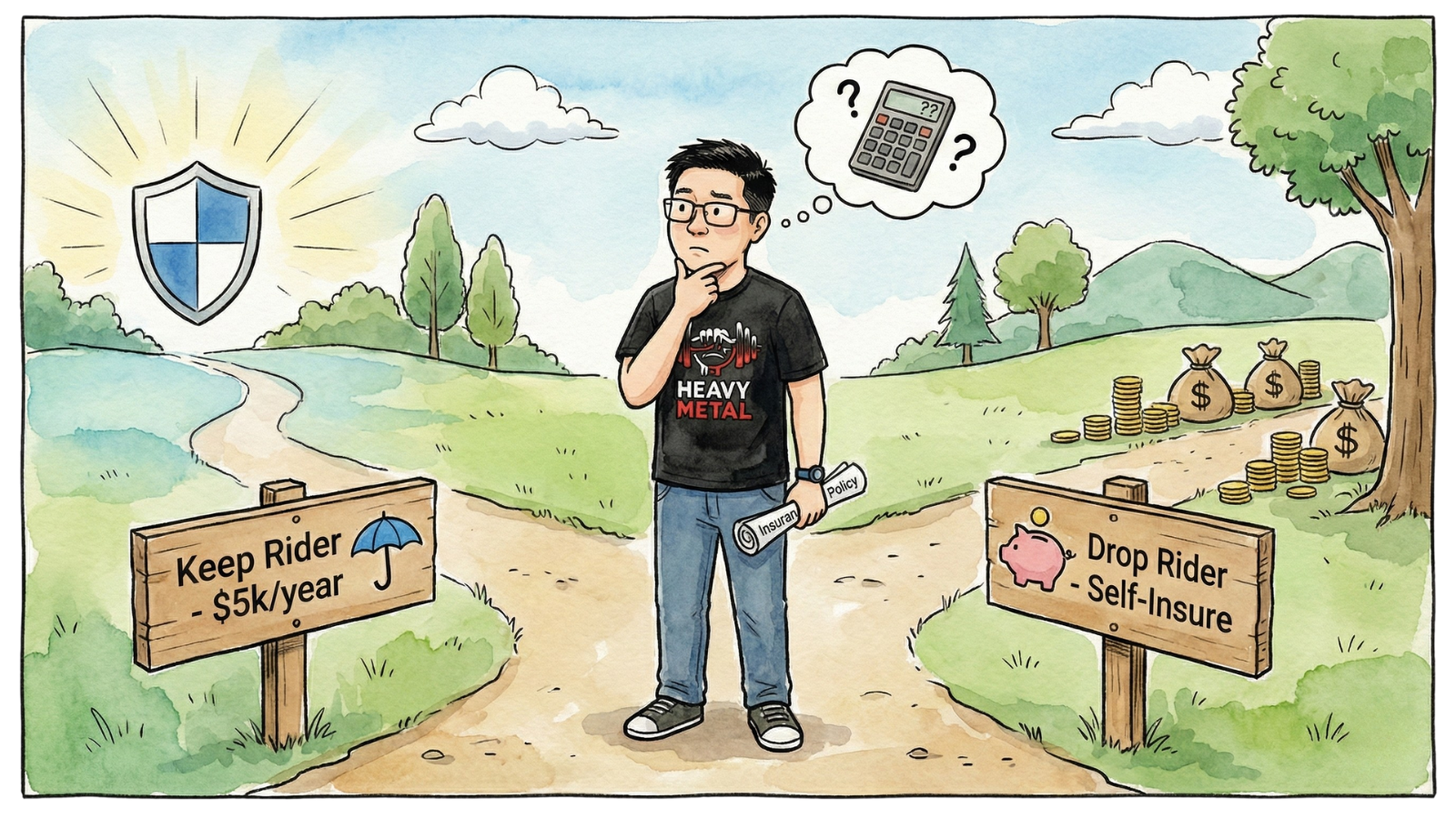
If you decide your rider isn’t worth the cost anymore, here’s what to do instead.
Keep your main plan. This is non-negotiable. The main plan is what gives you private hospital access and covers the bulk of your bills. Dropping the rider doesn’t mean going uninsured. It means accepting a $3,500 deductible and 10% co-insurance in exchange for lower premiums.
Self-insure the deductible with your emergency fund. Set aside $3,500 to $5,000 in an accessible savings account. Label it “hospital deductible fund.” If you need surgery, you’ll pay the deductible out of this fund. If you don’t, the money stays with you, not with the insurer.
Redirect premium savings to other coverage. If you’re saving $4,000 per year by dropping your rider, redirect some of that to critical illness or disability income coverage. Riders protect you from hospital bills. CI and disability income protect you from lost income during illness. For most people, income protection matters more.
Review your plan annually. Health needs change. Premiums change. What makes sense at 55 might not make sense at 65. Check in every year and adjust as needed.
Consider switching to a lower-cost main plan if you’re dropping the rider anyway. Some insurers offer lower-premium main plans with slightly higher deductibles or co-insurance. If you’re comfortable self-insuring, this might be a way to reduce overall insurance costs further.
What About Cancer Coverage (CDL)?
One concern people have when dropping riders is cancer coverage. Specifically, the Cancer Drug List (CDL), which covers expensive outpatient cancer drugs.
Here’s the good news: CDL coverage is part of your main plan, not your rider.
Main plans typically cover five to nine times your annual claim limit for CDL. Riders can increase this to 18 times or more. But the baseline coverage exists without the rider.
For most people, the main plan’s CDL coverage is sufficient. If you’re diagnosed with cancer and need targeted therapy drugs, the main plan will cover a significant portion. The rider increases the cap, but it doesn’t create the coverage.
If cancer risk is your main concern when evaluating your rider, focus on your critical illness coverage instead. CI pays a lump sum on diagnosis, which you can use for treatment costs, income replacement, or anything else you need. That’s often more valuable than increasing your CDL cap from 9x to 18x.
The Bottom Line: It Depends on Your Situation
Riders reduce deductibles and co-insurance. That’s valuable for some people. For others, the cost outweighs the benefit.
The answer isn’t “riders are good” or “riders are bad.” It’s “does the cost match the value for my specific situation?”
If you’re young, paying low premiums, or have chronic conditions requiring frequent hospital stays, riders make sense.
If you’re over 50, paying $4,000 to $9,000 per year, and rarely hospitalized, the math might not work in your favor.
Run the numbers. Factor in your health, your risk tolerance, and your liquidity. Then decide.