

Updated for the CPF rules and retirement sums applicable in 2026
For many Singaporeans, 55 is imagined as the age when the CPF vault finally opens.
That picture is understandable, but wrong.
Turning 55 does not mean that all your CPF savings suddenly become cash. It also does not mean that CPF starts paying you a monthly income. What actually happens is more administrative and, from a retirement-planning perspective, more important: your accounts are reorganised, part of your savings is set aside for retirement, and any amount that is eligible for withdrawal becomes accessible.
In other words, age 55 is not the end of the CPF journey. It is the point at which CPF begins converting the savings you accumulated during your working years into the foundation for income later in life.
Here is what happens, step by step.
1. A Retirement Account is created for you
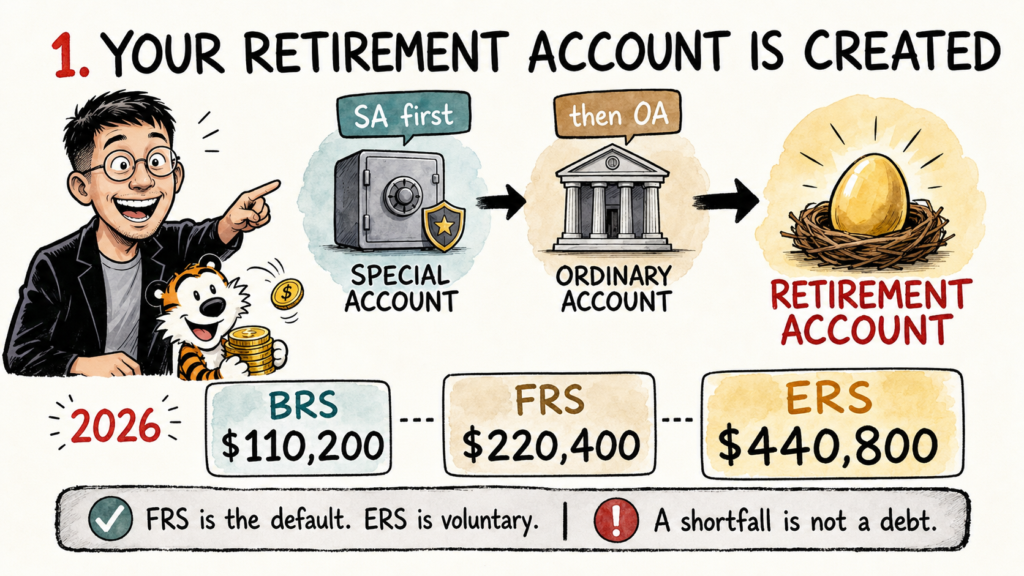
On your 55th birthday, CPF creates a Retirement Account, commonly called the RA.
Money is then transferred into the RA from your Special Account first, followed by your Ordinary Account, up to your cohort’s Full Retirement Sum. Your cohort is determined by the year in which you turn 55, and that retirement sum remains applicable to you thereafter.
For someone turning 55 in 2026, the retirement sums are:
| Retirement sum | Amount at age 55 | What it represents |
|---|---|---|
| Basic Retirement Sum (BRS) | $110,200 | A reference amount for basic living needs, excluding rent |
| Full Retirement Sum (FRS) | $220,400 | Twice the BRS and the default amount set aside in the RA |
| Enhanced Retirement Sum (ERS) | $440,800 | The 2026 maximum to which members aged 55 and above may top up their RA |
The ERS is not an amount CPF automatically takes from you. It is a voluntary ceiling for people who want to commit more money to CPF in exchange for higher lifelong payouts.
This is the first misconception to clear up: you do not have to write a cheque if your CPF savings are below the FRS. CPF transfers what is available, subject to the withdrawal rules. A shortfall is not a debt owed to CPF.
2. Your Special Account closes
This is the biggest difference between turning 55 today and turning 55 in the past.
Before 2025, members could continue to have a Special Account after 55. This created a particularly attractive arrangement for those with savings above the FRS: surplus SA money could remain liquid while continuing to earn the long-term CPF interest rate.
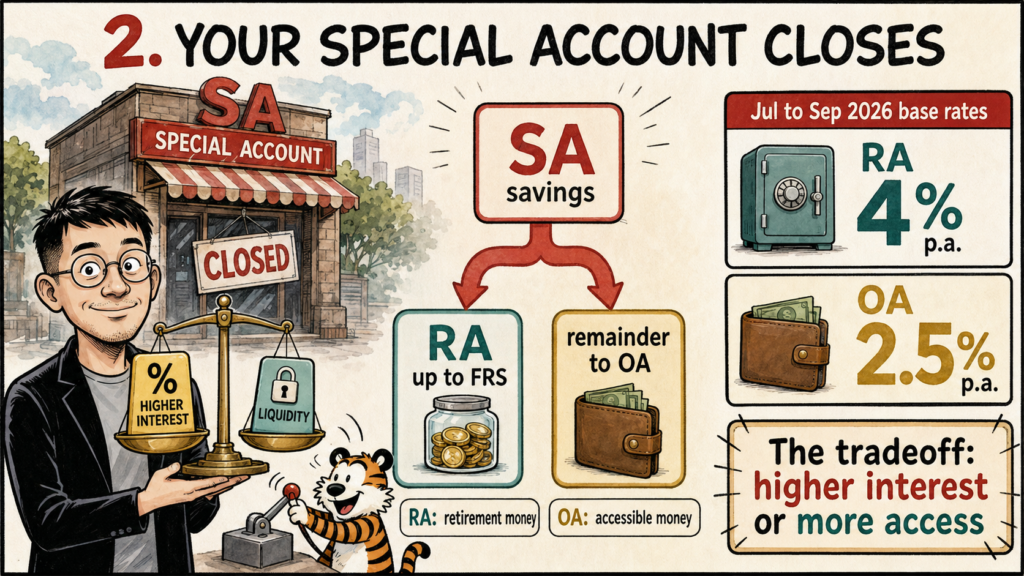
That arrangement ended on 19 January 2025. Today, when you turn 55, your SA savings are first used to fill your RA up to the FRS. Your SA is then closed, and any remaining SA savings are transferred to your OA.
The destination now matters:
- Money committed to the RA continues to earn the long-term CPF rate and is meant to support retirement payouts.
- Surplus money moved to the OA remains withdrawable, but earns the OA rate instead.
For October to December 2026, the published base rates are 4% a year for the RA and 2.5% for the OA. CPF rates are reviewed periodically and should not be assumed to remain unchanged forever.
This change removed what planners sometimes called the “SA shielding” advantage: enjoying SA-level interest on money that remained withdrawable after 55. The trade-off is now more explicit. If you want liquidity, the money generally sits in the OA at the short-term rate. If you want the long-term rate, you must generally commit the money to the RA, where withdrawal is restricted and the funds support future payouts.
3. You may withdraw some money, but not necessarily all of it
Once the RA has been created, the amount you can withdraw depends on your balances and circumstances.
Broadly:
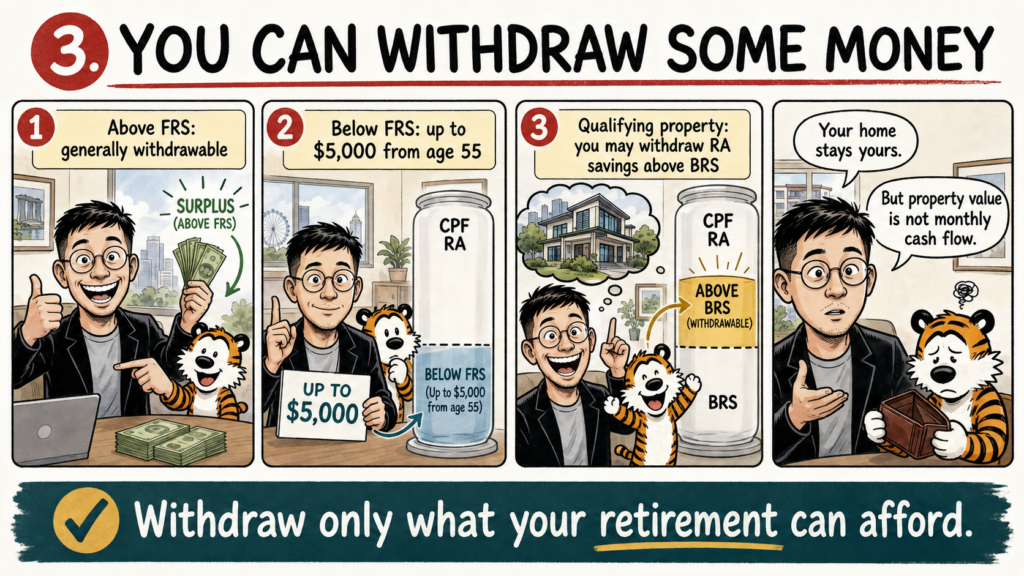
- If you have set aside the FRS in your RA, savings above it that remain in your OA are withdrawable.
- If you cannot set aside the FRS, you may still withdraw up to $5,000 from age 55.
- If you own a qualifying Singapore property, you may be able to withdraw RA savings above the BRS, because part of the FRS can be supported by the value of the property.
The property option is often described too casually as “pledging your property”. CPF does not take ownership of your home. But the withdrawal is not free of future consequences either. Depending on how the withdrawal is made and how much CPF was used for the property, a sale or transfer may require CPF refunds: including accrued interest, to restore your retirement savings, subject to the applicable rules.
Property eligibility and the amount withdrawable depend on details such as the remaining lease, property value, outstanding loan, ownership share and past CPF usage. Treat the BRS as a planning reference, not an automatic promise that everyone with a home can immediately withdraw everything above it.
There is also no requirement to withdraw as soon as you become eligible. You can leave withdrawable OA savings in CPF and take them later. The real question is not, “How much can I withdraw?” It is, “How much should I withdraw without weakening my later income?”
4. Your MediSave Account is not emptied into retirement
Your MediSave Account remains separate. The creation of your RA does not mean your MediSave savings are swept into it.
MediSave continues to serve healthcare purposes, including eligible medical expenses and approved insurance premiums, subject to CPF rules and withdrawal limits. If your MediSave balance exceeds the applicable Basic Healthcare Sum, excess contributions may flow to another CPF account depending on your age and whether you have met the relevant retirement sum.
This separation is deliberate: retirement income and healthcare funding are related needs, but CPF does not treat them as the same pool of money.
5. Your monthly payouts generally do not start at 55
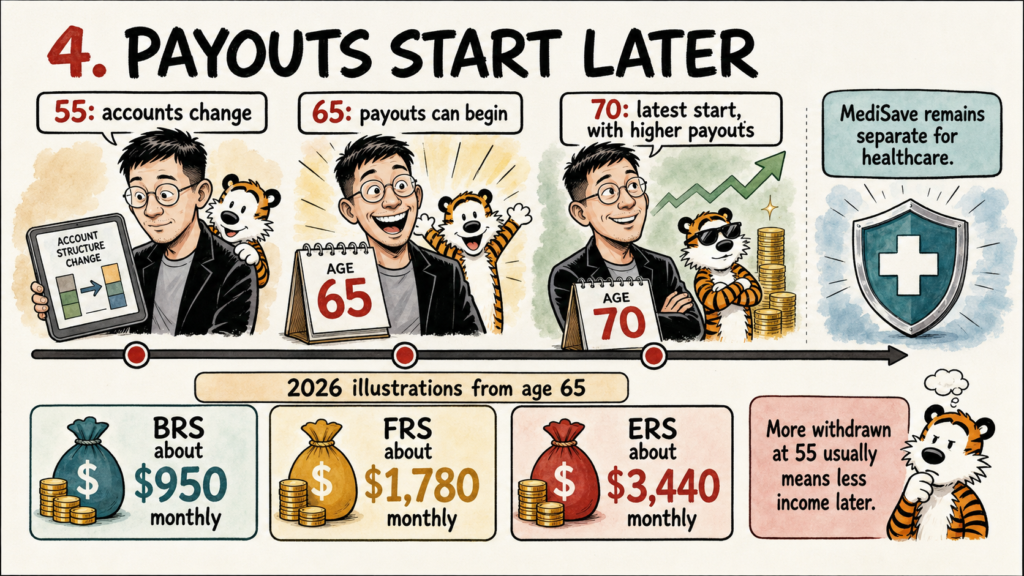
Age 55 is the retirement-account milestone. Age 65 is generally the payout milestone.
From your Payout Eligibility Age—currently 65—you can start monthly payouts. You may also choose to defer the start, up to age 70, in return for higher payouts. For eligible members, CPF LIFE converts retirement savings into an income that continues for life, rather than paying only until an individual account runs dry.
CPF’s 2026 illustrations estimate that a member turning 55 in 2026 and starting the CPF LIFE Standard Plan at 65 may receive about:
| RA savings at 55 | Estimated payout from 65 |
|---|---|
| $110,200 (BRS) | $950 a month |
| $220,400 (FRS) | $1,780 a month |
| $440,800 (ERS) | $3,440 a month |
These are estimates, not personal guarantees. Actual payouts depend on factors including your sex, age when payouts start, CPF LIFE plan, RA balance, interest and future CPF LIFE parameters.
The planning principle, however, is stable: withdrawing more at 55 leaves less to compound and generally produces lower lifelong income later.
What happens if you keep working after 55?
Your CPF does not stop because you have reached 55.
Employer and employee contributions continue if you remain employed and eligible, although contribution rates change by age band. With the SA closed, contributions that would previously have gone into it are allocated to the RA until the FRS is met; after that, the relevant amount generally goes to the OA. Contributions also continue to be allocated to MediSave under the prevailing rules.
This means the picture at 55 is not frozen. Your RA can continue growing through contributions, transfers, cash top-ups and interest. Members aged 55 and above also receive extra interest on the first portion of their combined CPF balances, subject to CPF’s account caps and allocation rules.
The system has changed because the retirement problem has changed
Anyone who has followed CPF for the last two decades will recognise a clear shift.
The older public conversation centred on the “Minimum Sum” and how much could be taken out at 55. But rising longevity made a lump-sum mindset increasingly inadequate. CPF LIFE was introduced in 2009 to address the risk of outliving one’s savings. In 2016, the Minimum Sum terminology gave way to the BRS, FRS and ERS framework, linking different levels of retirement savings more clearly to different payout levels. In 2025, the ERS rose from three to four times the BRS, while the SA was closed for members aged 55 and above.
The direction is unmistakable: CPF has evolved from being perceived mainly as a pool of compulsory savings into a system designed to produce lifelong retirement income.
Whether one agrees with every policy choice is a separate question. There is a genuine tension between personal liquidity and protection against longevity risk. The closure of the SA made that tension sharper by ending the ability to keep surplus, withdrawable savings at the long-term rate. But it also made the account structure more consistent: liquid savings earn the liquid-account rate; retirement-committed savings earn the long-term rate.
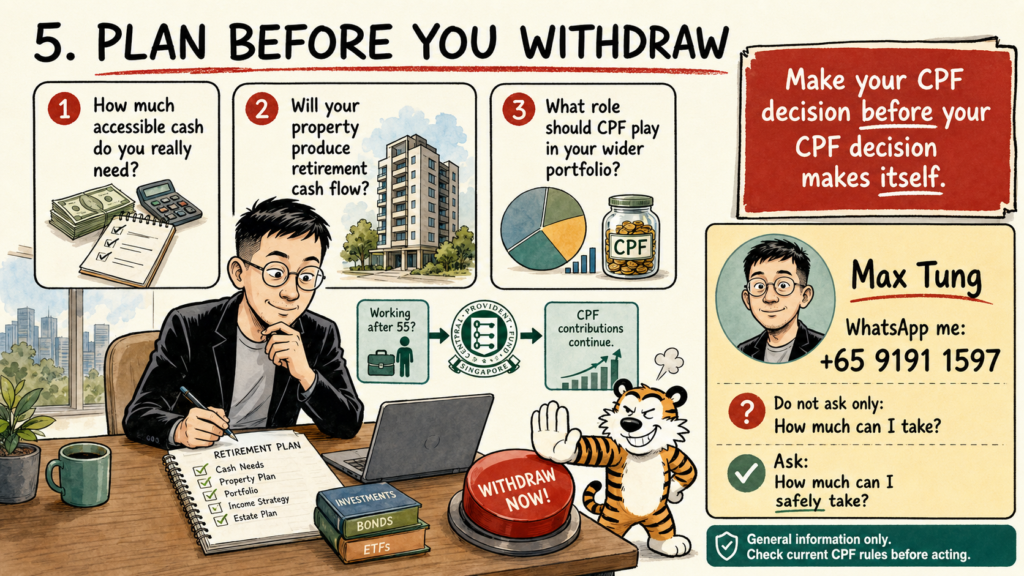
Three decisions to make before your 55th birthday
1. Decide how much liquidity you genuinely need
Do not withdraw simply because the money has become available. Ring-fence near-term needs—such as debt repayment, home repairs, dependants’ support or a sensible emergency reserve—then compare those needs with the retirement income you would give up.
2. Decide whether your property should support a withdrawal
A home is valuable, but it is not monthly cash flow unless you sell, rent out a room, right-size or otherwise monetise it. If you withdraw down towards the BRS on the strength of a property, be honest about how that property will eventually support retirement spending.
3. Decide what role CPF should play in your wider portfolio
RA money can be valuable as the stable-income portion of a retirement plan. But topping up the RA is largely an irreversible liquidity decision, not merely a search for a higher interest rate. Compare it against your need for accessible cash, market investments, insurance, family commitments and estate objectives.
The bottom line
What actually happens to your CPF at 55 is less dramatic than the folklore suggests.
A Retirement Account is opened. Your SA and then OA savings are used to set aside up to the FRS. Your SA closes and any surplus moves to the OA. Eligible excess savings become withdrawable. Your MediSave remains for healthcare. Your eventual monthly income normally begins from 65, not 55.
The administrative process is automatic. The financial decisions are not.
The wrong way to approach 55 is to ask only, “How much can I take out?” The better question is:
How much can I safely take out while preserving the retirement income I will need if I live much longer than expected?
That is the question CPF at 55 is really asking you to answer.
This article is for general information and does not constitute personalised financial advice. CPF rules, interest rates and payout estimates can change. Check your Retirement Dashboard and the latest information from CPF Board before acting.
Official sources
- CPF Board, Reaching age 55
- CPF Board, What is the CPF retirement sum?
- CPF Board, Closure of Special Account for members aged 55 and above
- CPF Board, Withdrawing for immediate retirement needs
- CPF Board, Earning CPF interest
- CPF Board, Save & Sound: 70 Years of CPF