
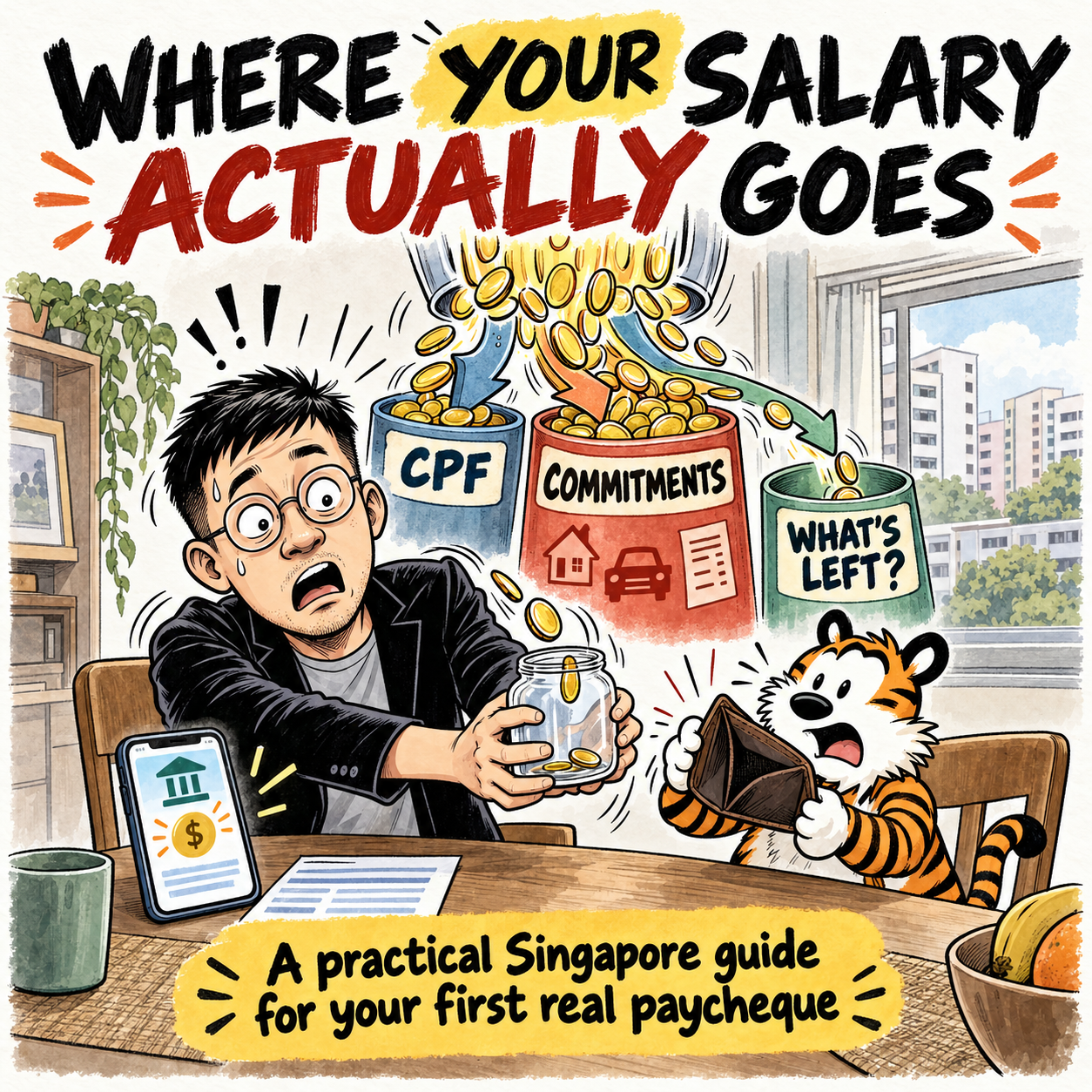
A practical Singapore guide for your first real paycheque
You worked hard to earn more. You survived school, interviews, probation, and the awkward first months of learning how an office really works. So when your salary rises, you expect your bank balance to feel different. Then payday comes, a few payments leave, and by the final week the account looks strangely familiar.
That can feel like a personal failure. Usually, it is a visibility problem.
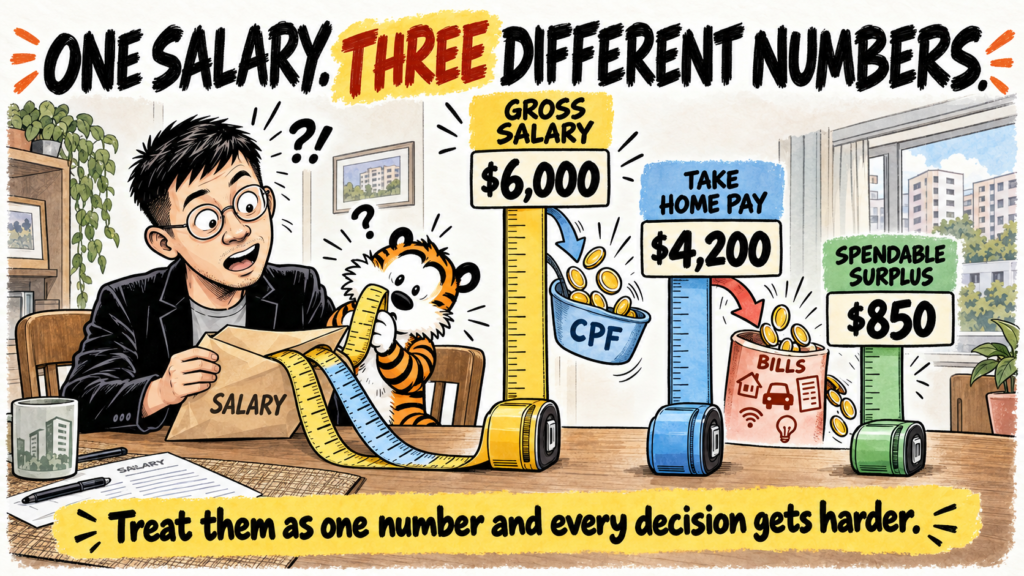
The hidden truth is simple: your gross salary, take home pay, and spendable surplus are three different numbers. If you treat them as one number, every financial decision becomes harder than it needs to be.
Get this distinction right and you can build savings, protection, and investments without feeling permanently deprived. Get it wrong and each pay rise quietly becomes permission for more commitments.
The Pay Rise Mirage
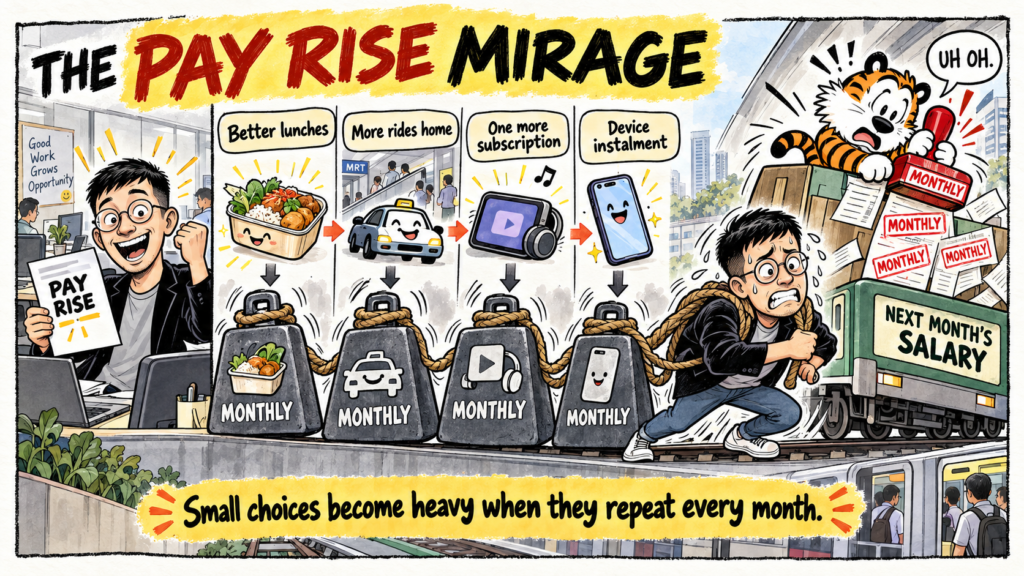
The most common trap at this stage is what I call the Pay Rise Mirage. Your salary goes up, so your mind updates your lifestyle before your bank balance has had time to update your future.
A better lunch here, a few more rides home there, one subscription that seems harmless, and a phone plan that now includes a device payment. None of these choices is absurd. The problem appears when several reasonable choices become permanent at the same time.
People often focus on kopi, streaming, or the occasional meal with friends because these purchases are easy to see. Yet the biggest pressure usually comes from commitments that repeat automatically. Once a cost becomes monthly, your future salary arrives with instructions already attached.
This is also why the sudden coffee invitations from friends who joined the financial services industry can feel uncomfortable. You know protection matters, but you do not want a social conversation to become a sales process before you understand your own numbers.
What I Have Seen Across the Table
I have sat with young professionals who earned respectable salaries and still felt embarrassed that they had little to show for them. Their spending was rarely outrageous. Most simply had never separated money that was already committed from money that was genuinely available.
Once we mapped the salary, CPF, and fixed commitments on one page, the shame usually disappeared. The problem became measurable. More importantly, the next step became obvious.
The One Salary Rule
Build your life around the money that remains after CPF and fixed commitments, then give that remainder a job before the month begins.
The Order That Makes the Rest Easier
The order matters because each step sets a boundary for the next one. Investing before you know your cashflow can force you to sell at the wrong time. Buying protection before you know what you need can lock too much money into premiums. Saving whatever remains at month end usually means saving whatever your habits happen to leave behind.
1 Map the salary that reaches you
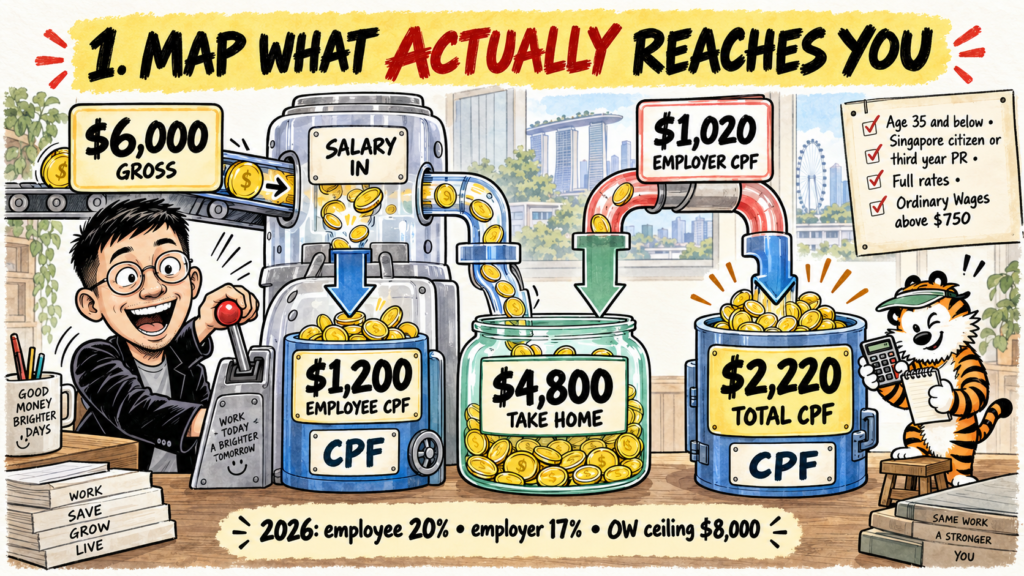
For a Singapore citizen or third year permanent resident aged 35 and below, earning more than $750 a month, the employee contribution rate in 2026 is 20 percent and the employer contribution rate is 17 percent. The monthly salary ceiling for Ordinary Wages is $8,000.
If your gross monthly salary is $6,000, about $1,200 goes from your wages to CPF and about $4,800 reaches your bank account before any other deductions. Your employer contributes another $1,020. That means your total CPF contribution is about $2,220, even though only the employee share reduces the pay that reaches your bank account.
| Gross salary | Employee CPF | Take home pay | Employer CPF | Total CPF |
| $4,500 | $900 | $3,600 | $765 | $1,665 |
| $6,000 | $1,200 | $4,800 | $1,020 | $2,220 |
| $8,000 | $1,600 | $6,400 | $1,360 | $2,960 |
These examples assume the full contribution rates and do not cover first or second year permanent resident rates, special wage bands, Additional Wages, or payroll rounding. Use the CPF calculator for your exact amount.
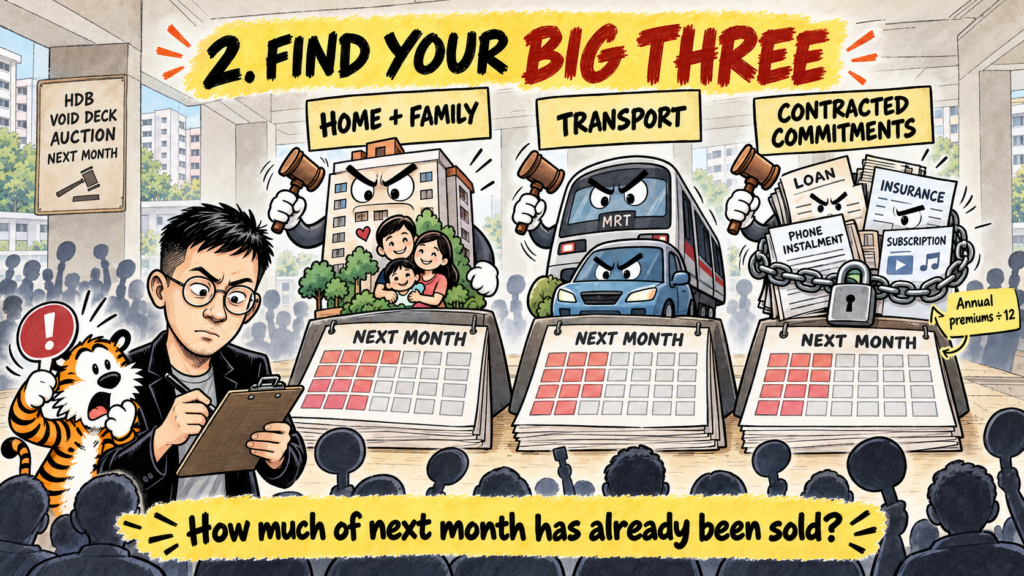
2 Find your Big Three
Your Big Three are the recurring commitments that consume the largest part of your take home pay. For many young working adults in Singapore, they are home and family contributions, transport, and contracted commitments such as debt repayments, insurance premiums, phone instalments, or other plans that are difficult to stop next month.
Write down the actual monthly amount for each. Annual premiums should be divided by twelve. Irregular obligations should receive a realistic monthly allowance. The goal is not to judge the spending. The goal is to see how much of next month has already been sold.
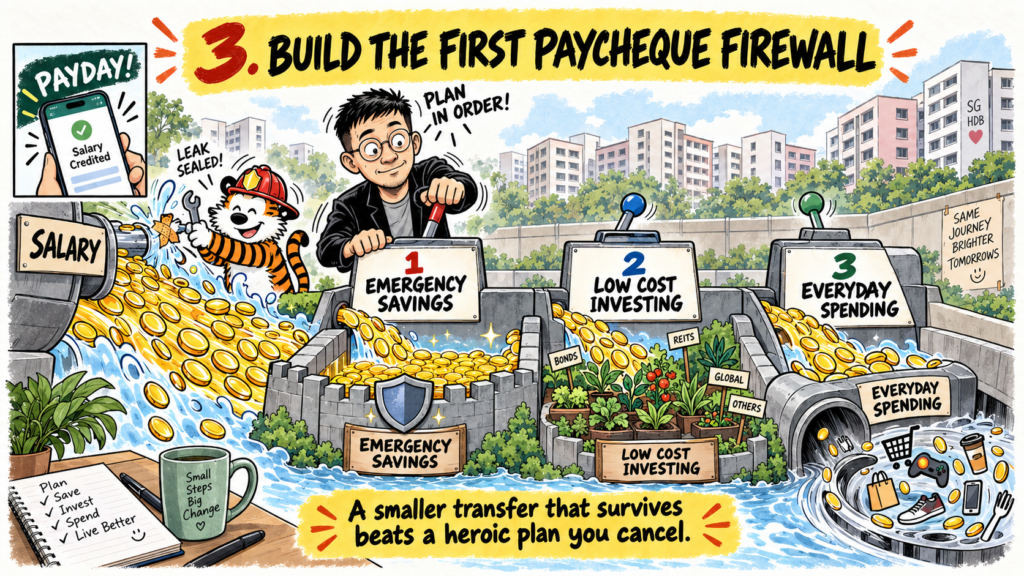
3 Create the First Paycheque Firewall
The boring step is separating money early. I call it the First Paycheque Firewall because it stops ordinary spending from consuming goals that matter more.
On payday, move a planned amount into a separate emergency savings account. After you have a suitable cash buffer, direct the next planned amount toward a simple, diversified, low cost investment approach that fits your time horizon and risk capacity. Automation reduces the number of decisions you need to make when work becomes busy.
Start with an amount you can repeat through an ordinary month. A smaller transfer that survives is more useful than an ambitious transfer you cancel after six weeks.
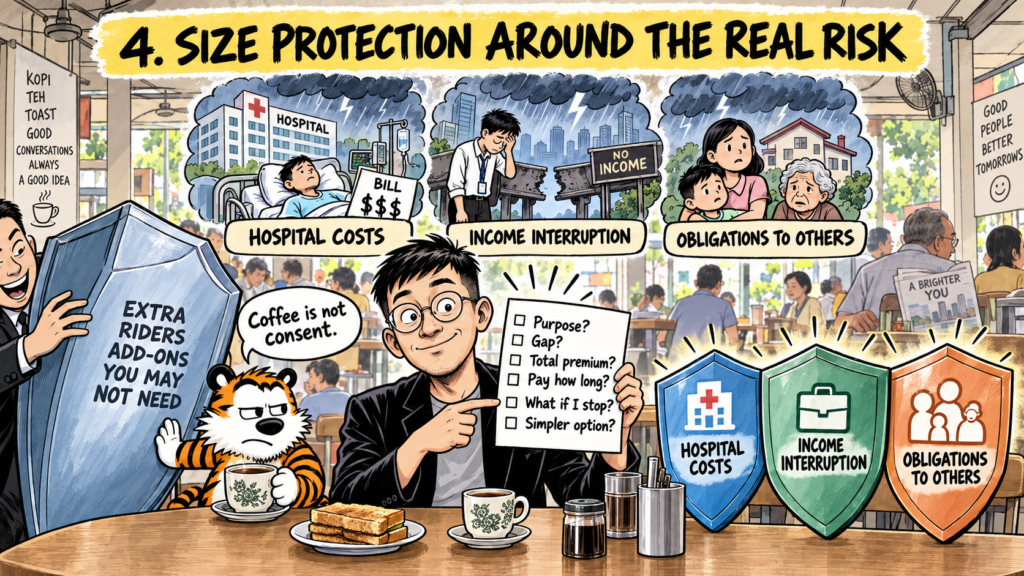
4 Size protection around the real risk
At this stage, insurance should protect the parts of your financial life that would be difficult to rebuild. Hospitalisation costs, a long interruption to income, and obligations that would fall on someone else deserve attention. The amount and type of cover should follow your actual exposure, employer benefits, existing CPF related coverage, and budget.
Being invited for coffee does not create a duty to buy. Ask for the purpose of every recommendation, the gap it addresses, the total premium, how long you must pay, what happens if you stop, and whether a simpler option addresses the same risk. A good adviser should welcome those questions.
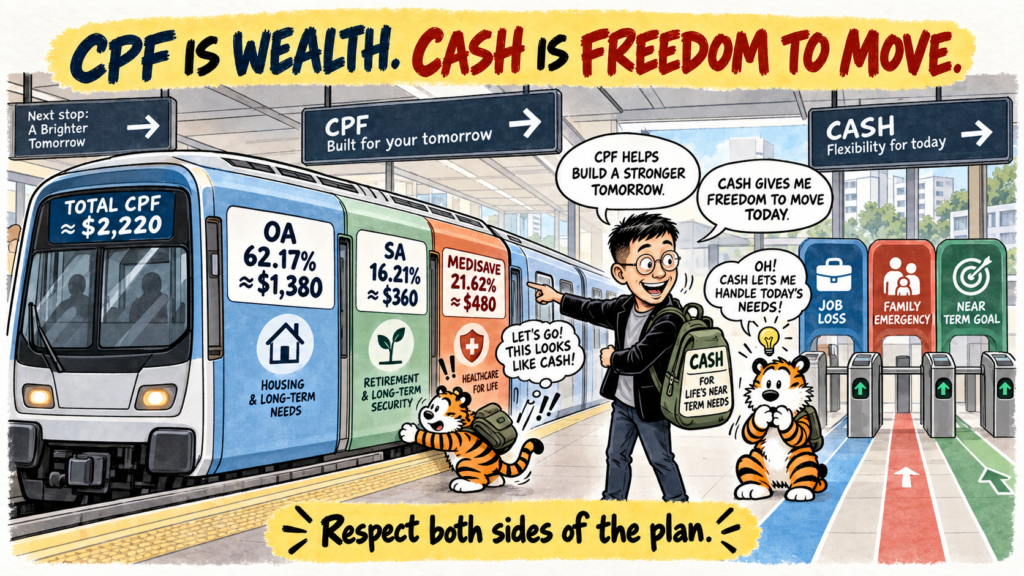
CPF Is Part of Your Wealth but Not All of Your Wallet
A common myth says that CPF is either money you should ignore completely or money that means you do not need to save elsewhere. Both views distort the plan.
For someone aged 35 and below, the combined 2026 CPF contribution is allocated by ratio: 62.17 percent to the Ordinary Account, 16.21 percent to the Special Account, and 21.62 percent to MediSave. If the total contribution is about $2,220, the allocation is approximately $1,380 to OA, $360 to SA, and $480 to MediSave.
That money has real value. It supports housing, retirement, and healthcare within CPF rules. Yet it does not replace cash for a sudden job loss, a family emergency, or a near term goal. Good planning respects both sides. CPF builds part of your balance sheet while cash keeps your options open.
Two People With the Same Pay
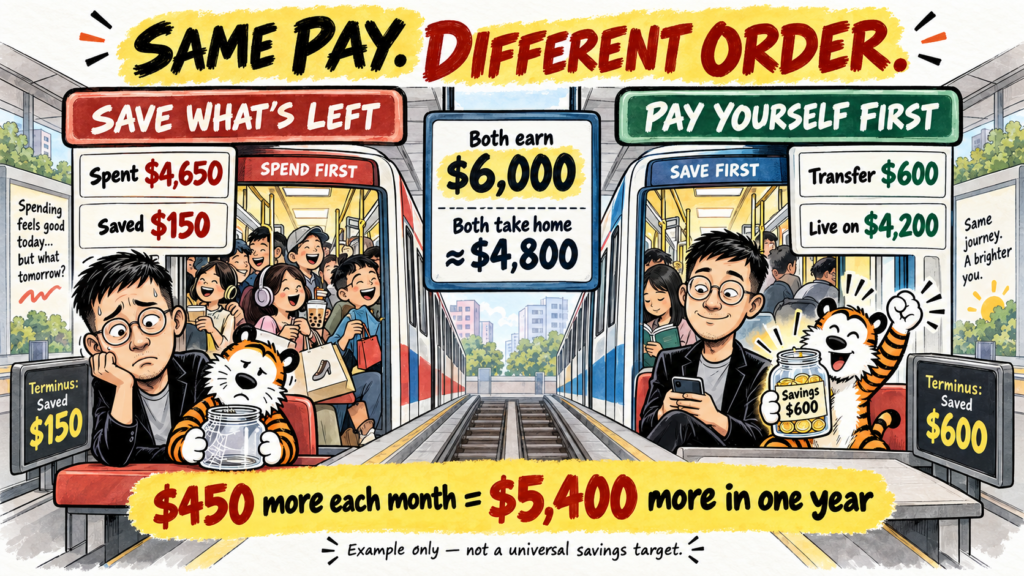
Imagine you and a friend both earn $6,000 a month. Each receives about $4,800 after the employee CPF contribution. Your friend waits until the end of the month to save. You transfer $600 on payday and live on the remaining $4,200 after checking that your fixed commitments fit.
If your friend happens to spend $4,650, only $150 gets saved. You save $450 more that month because the decision happened before daily life became noisy. Over a year, that difference is $5,400 before any investment return. The powerful change is not a clever product. It is the sequence of decisions.
This does not mean $600 is the correct number for everyone. It means the savings decision should come from your own surplus, goals, and resilience rather than whatever remains by accident.
The Social Pressure Comes After the Plan
Once you set boundaries, the friction changes. Friends may spend more freely. Family members may assume a salary increase means you can contribute more. A salesperson may imply that delaying a purchase is irresponsible. You may also feel impatient when your first few months of progress look small.
Do not answer that pressure with deprivation or defensiveness. Return to the map. If the expense fits after your commitments and planned saving, enjoy it. If it requires borrowing from next month or cancelling a goal you care about, recognise the trade clearly.
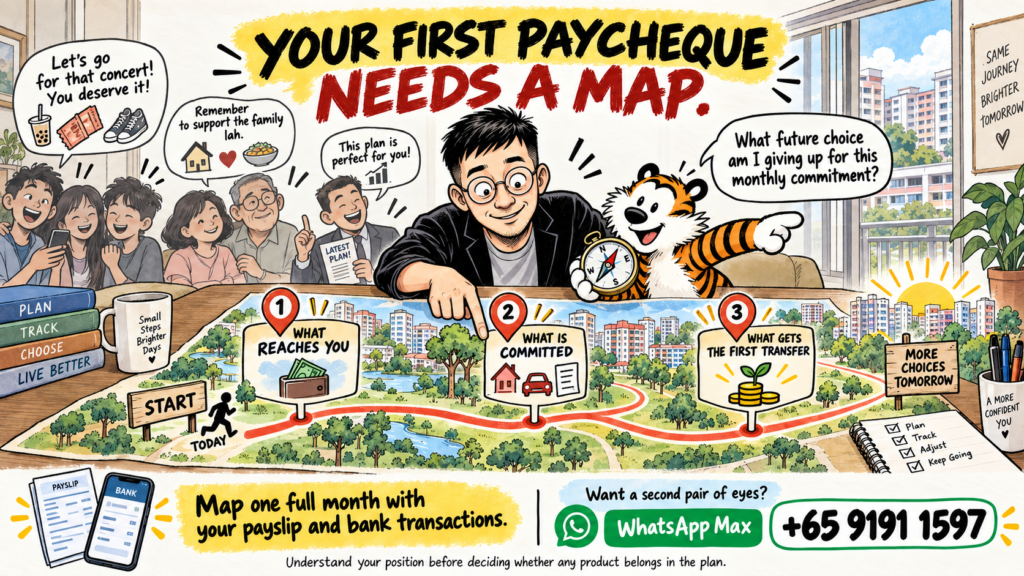
When you feel stuck, ask: what future choice am I giving up to make this monthly commitment today?
Your first real paycheque does not need a perfect investment portfolio or a shelf full of policies. It needs a clear map. Once you know what reaches you, what is already committed, and what deserves the first transfer, the rest of financial planning becomes far less mysterious.
A Simple Next Step
Map one full month using your actual payslip and bank transactions. If you would like a second pair of eyes on the numbers, WhatsApp me at +65 9191 1597. The first conversation should help you understand your position before you decide whether any product belongs in the plan.
Sources and Important Notes
CPF allocation rates from 1 January 2026: https://www.cpf.gov.sg/content/dam/web/employer/employerobligations/documents/CPFAllocationRatesfromJanuary2026.pdf
CPF monthly and annual salary ceilings: https://www.cpf.gov.sg/member/infohub/news/cpf-related-announcements/budget-highlights-2023
CPF contribution calculator: https://www.cpf.gov.sg/member/tools-and-services/calculators/cpf-contribution-calculator
This article is general educational information. CPF calculations can vary with age, citizenship status, permanent resident year, wage level, Ordinary Wages, Additional Wages, and payroll rounding. Financial products involve costs and risks. Consider your circumstances and seek appropriate advice before acting.