
You’ve barely settled into life with your newborn when the advice starts.
“Buy insurance while they’re young.”
“Get a hospital plan first.”
“Start an education plan now.”
Everyone sounds certain. Meanwhile, you’re wondering whether you’re being responsible by listening—or being sold something because you’re understandably worried about your child.
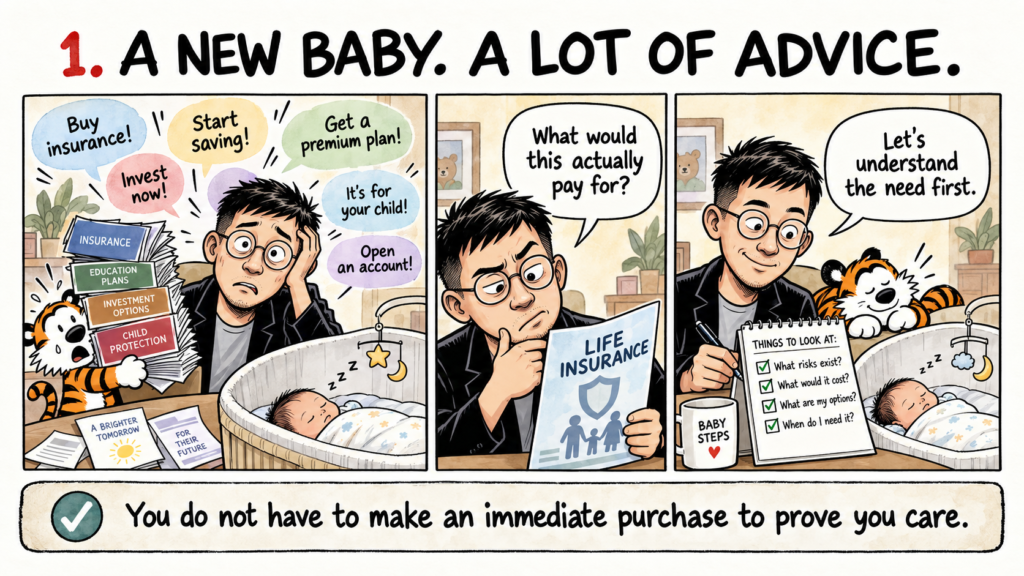
An insurance recommendation can be sensible. But “you’ve just had a baby” is only the beginning of an explanation.
Before committing, you should understand what the policy would pay for, what your family already has, and why this particular purchase deserves a place in your budget.
Here’s where to start.
Ask what “insure the baby” actually means
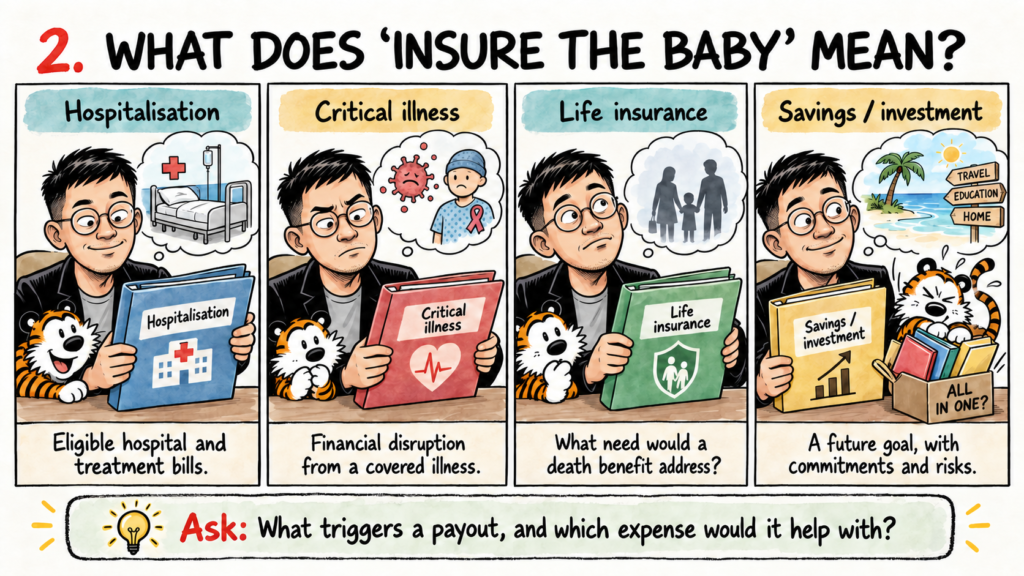
The phrase gets used as though it describes one decision. It can refer to several very different purchases.
| What’s being recommended? | The question it should answer |
|---|---|
| Hospitalisation insurance | How would we manage eligible hospital and treatment bills? |
| Critical illness cover | Would a payout help us manage the financial disruption if our child developed a covered illness? |
| Life insurance | What financial need would the death benefit address? |
| A savings or investment-linked policy | What future savings goal are we funding, and what commitments and risks come with it? |
These products have different purposes. A recommendation should explain the particular need it addresses. MoneySense makes the same distinction between insurance for protection and policies used for savings or investment. MoneySense’s insurance basics
A useful opening question is:
“What would have to happen for this policy to pay, and which expense would that payout help us manage?”
The answer should make sense without requiring you to understand an entire product brochure.
Find out what your baby already has
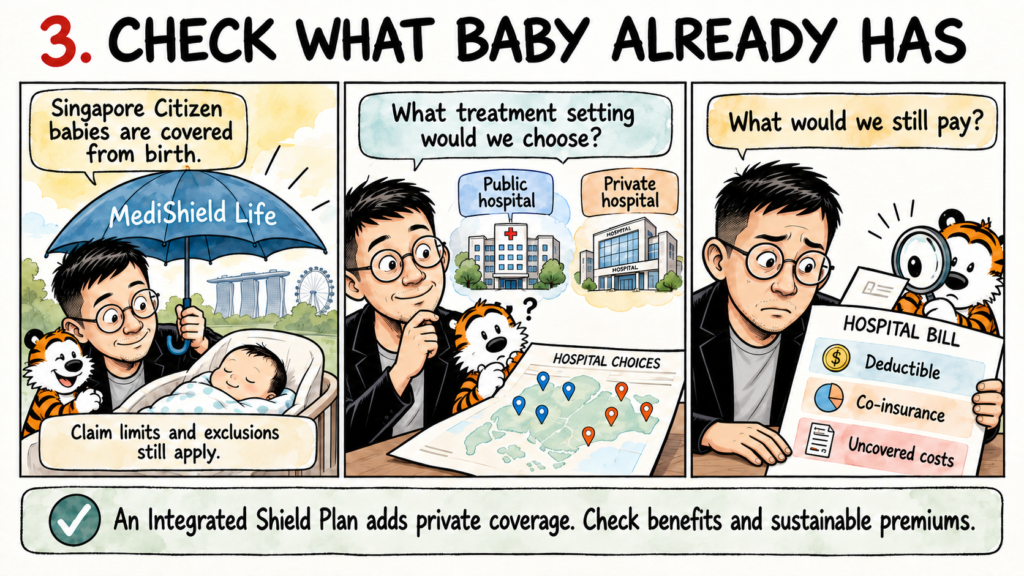
For Singapore Citizen babies, MediShield Life coverage starts automatically from birth, including for those with congenital illnesses or pre-existing conditions. Its benefits still have claim limits and exclusions. MOH’s newborn coverage guidance, MediShield Life benefits
That gives you a starting point for assessing additional coverage.
An Integrated Shield Plan adds private insurance coverage to MediShield Life. Depending on the plan, it can support treatment in higher ward classes in public hospitals or in private hospitals. The decision therefore involves your treatment preferences, the costs you would still bear, and the premiums you can sustain. MoneySense’s Integrated Shield Plan guide
Before comparing plans, discuss where you would realistically seek treatment.
Then ask the adviser to show you an example bill for that setting, including the deductible, co-insurance and any expenses the proposed policy would leave unpaid.
A policy’s headline claim limit tells you much less than understanding what you might still need to pay.
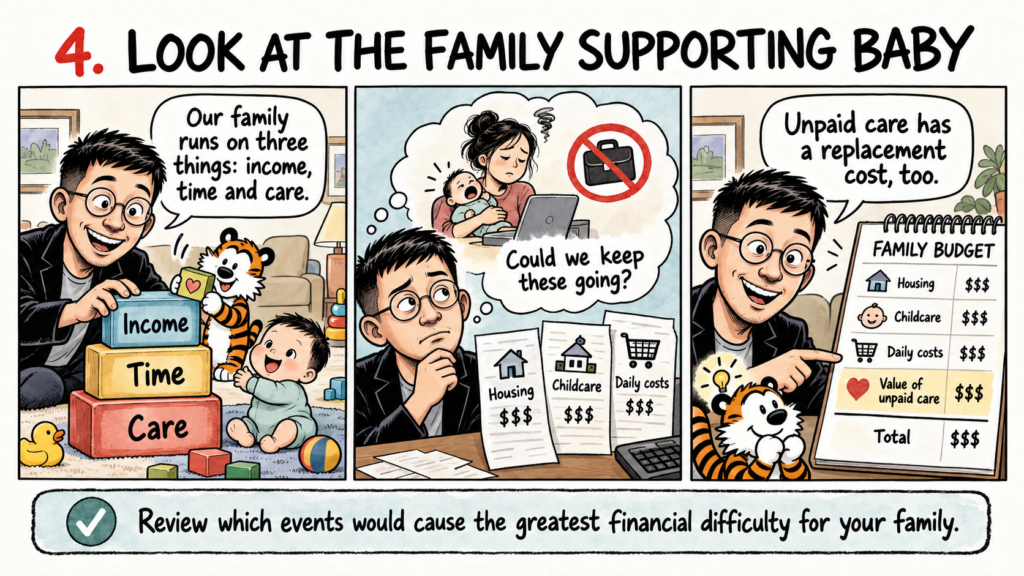
Look at the household that supports your child
Your baby depends on your income, your time and the care you provide.
Alongside reviewing the baby’s medical coverage, consider what would happen if a parent became seriously ill, could no longer work, or died.
Could the household continue paying for housing, childcare and daily expenses? Would someone need to reduce their working hours? If a parent who provides unpaid care became unwell, what would replacing that care cost?
These questions help you assess the family’s financial exposure. MoneySense recommends considering the financial loss you or your dependants could face when deciding what insurance you need. Assessing your insurance needs
For example, a family might be considering a substantial long-term policy for their child while having very little provision for the loss of a parent’s income. That is a reason to review how the budget is being allocated.
The aim is to understand which events would cause the greatest financial difficulty, then decide how to address them.
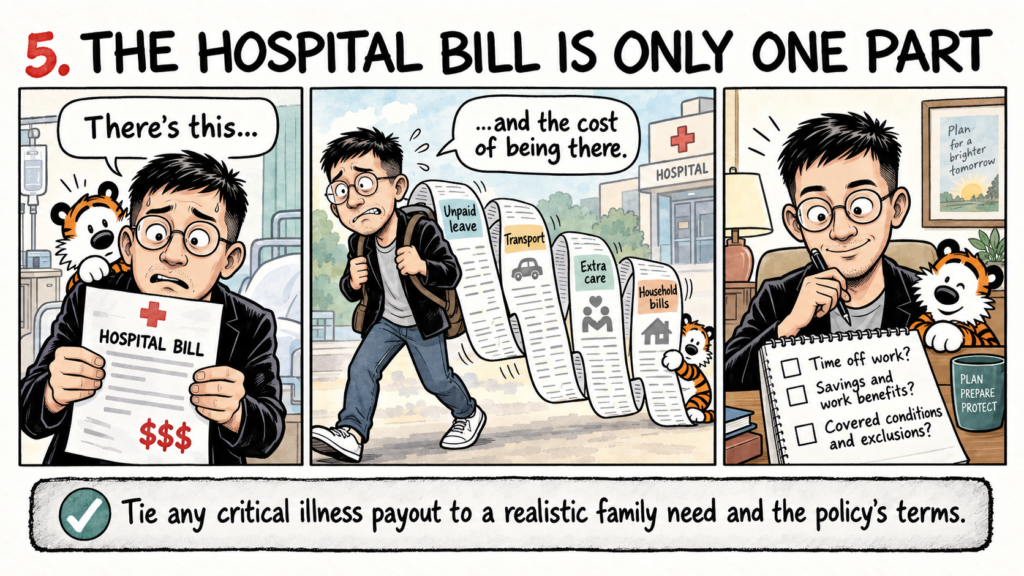
Separate medical bills from the cost of caring
If a child becomes seriously ill, the hospital bill may be only one part of the financial impact.
A parent might take unpaid leave. Transport and caregiving expenses might increase. Normal household bills would continue.
This is where a recommendation for critical illness cover deserves a specific discussion: what conditions qualify, how serious they must be, and how a potential payout would support the family.
Ask:
“How much time away from work are we trying to provide for?”
“What could our savings and employment benefits already cover?”
“Which diagnoses or circumstances would this policy exclude?”
A recommendation becomes easier to judge when the proposed amount is tied to a realistic family need.
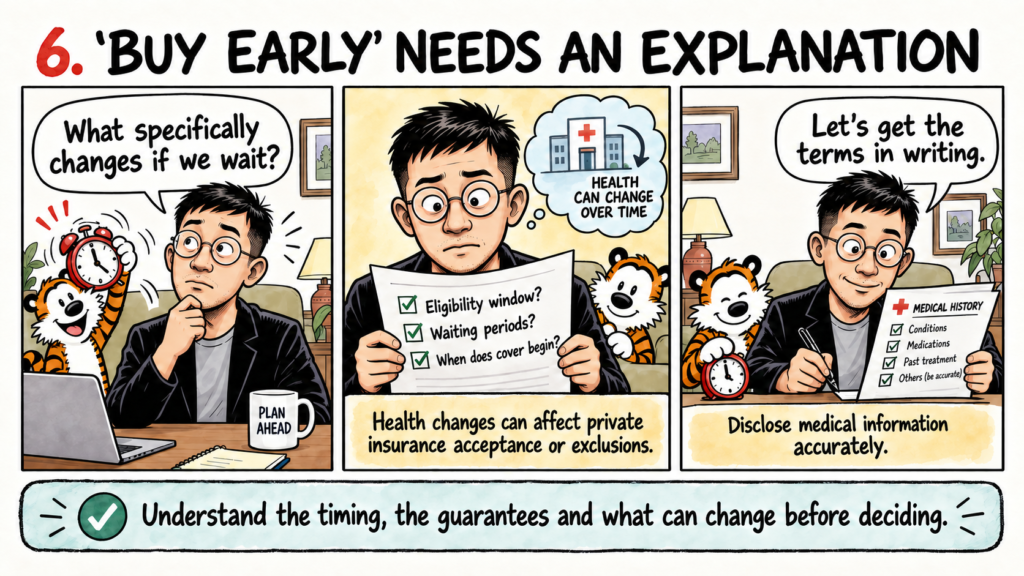
Treat “buy early” as a claim that needs explaining
There can be a genuine reason to consider coverage promptly. Developing a health condition before applying for private insurance can affect acceptance or result in exclusions. MoneySense’s financial planning FAQs
But that does not establish that every proposed policy is suitable.
If someone says you must act now, ask them to explain:
- What specifically could change if we wait?
- Is there a documented eligibility window?
- What medical information must we disclose?
- When would coverage begin, and are there waiting periods?
- Which benefits and premiums are guaranteed, and which can change?
Ask for the relevant terms in writing. Accurate disclosure matters; never leave out medical information to make an application easier.
You should be able to understand both the timing consideration and the product before deciding.
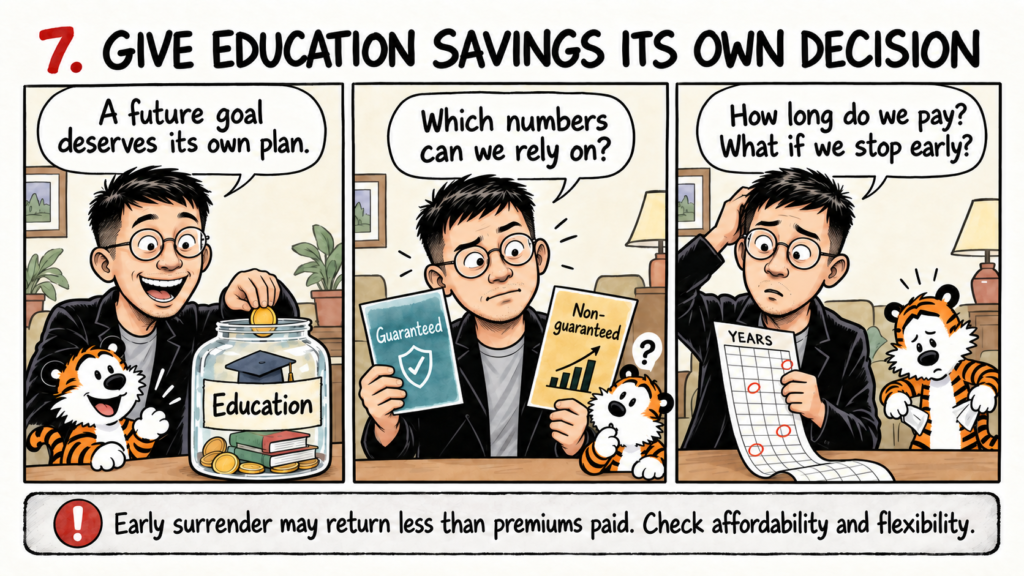
Give education savings its own decision
Wanting to start saving early is understandable. A future school bill can feel much more manageable when you begin setting money aside today.
If a policy is proposed for that purpose, ask about the guaranteed amount, any non-guaranteed projections, how long premiums must be paid, and what happens if you stop early.
MoneySense notes that terminating or surrendering a life insurance policy early may mean you do not recover the premiums paid. MoneySense’s buying guidance
Consider whether the commitment still fits if childcare costs rise or one parent takes time away from work. You should know how much flexibility you are giving up.
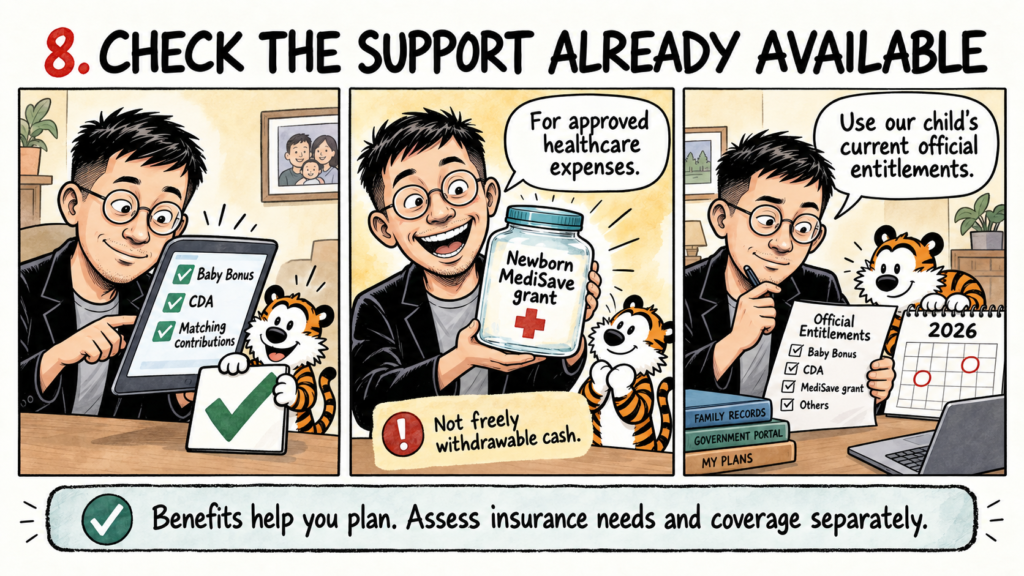
Check the grants already available to your family
Government benefits belong in this review because they help you understand your available resources.
Check your Baby Bonus enrolment, your child’s CDA and savings account, and any outstanding government matching contributions. Singapore’s announced transition to the SG Child Support Package starts in April 2027, so use your child’s current official record when checking entitlements. LifeSG’s support package guidance
Also check the MediSave Grant for Newborns. Eligible Singapore Citizen babies born on or after 1 April 2025 receive $5,000 in their MediSave account automatically. This money supports approved healthcare expenses; it is not freely withdrawable cash. MediSave grant guidance
These benefits have specific uses. Knowing what is available helps you plan, while insurance decisions still require a separate assessment of coverage and financial risk.
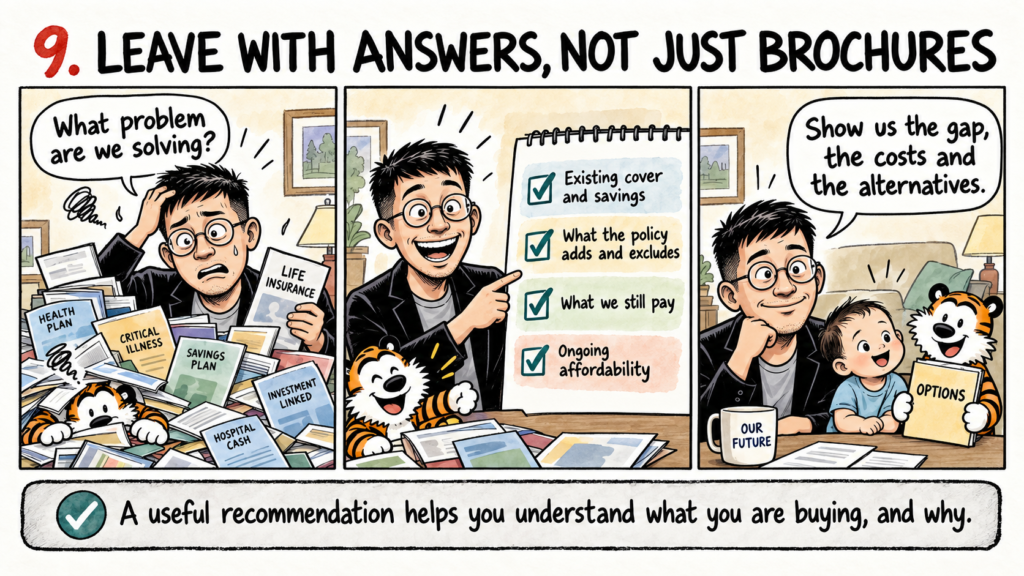
What a useful recommendation should leave you knowing
By the end of the conversation, you should be able to explain:
- The financial problem you are trying to solve.
- What existing coverage and savings already provide.
- What the proposed policy adds—and excludes.
- What you would still need to pay after a claim.
- Whether the ongoing commitment fits your family’s budget.
If those answers remain unclear, ask for clarification before committing.
You can say:
“Please show us what our child already has, the gap you’re recommending we cover, and why this option fits our family. We also want to understand the costs and alternatives.”
That is a reasonable request from parents making a consequential decision.
You do not need to prove you care about your baby by making an immediate purchase. You deserve advice that helps you understand what you are buying and why.