
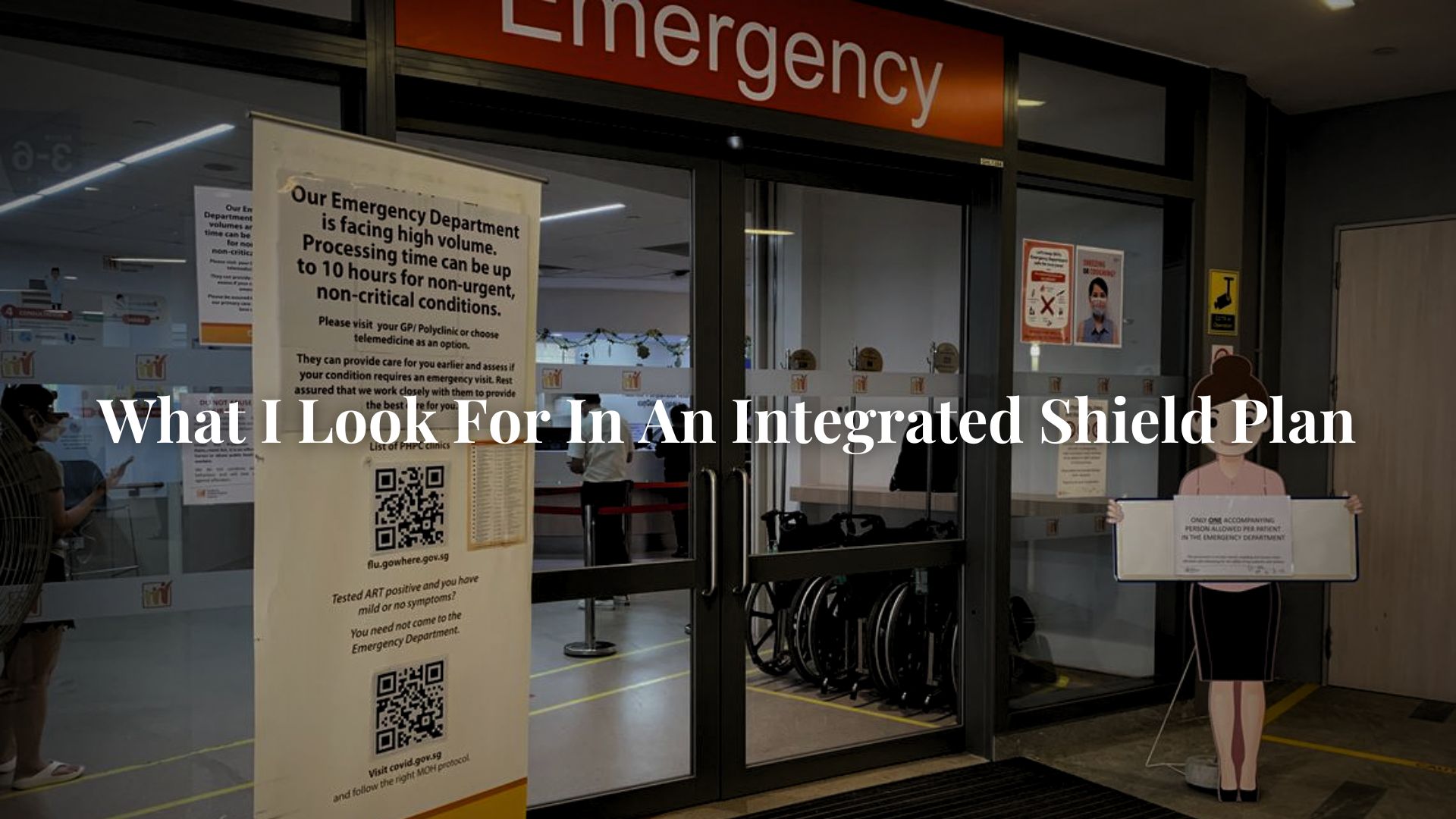
Things I Take Note Of When Choosing an Integrated Shield Plan
Every Singaporean is automatically covered under MediShield Life, but its coverage is limited. For example, the claim limits may not fully cover bills from private hospitals or certain treatments. That’s where an Integrated Shield Plan (IP) from a private insurer comes in – to protect you against large medical bills and prevent catastrophic financial losses.
In short, an Integrated Shield Plan covers your big hospital and surgical bills. But not all IPs are the same, so here are the key things I personally take note of when evaluating one:
1. Public vs Private Hospital Coverage
This is the first decision I’d make. Do I want coverage for private hospitals, or am I okay with public hospital coverage only?
- At public hospitals, waiting times are usually longer.
- At private hospitals, I get more flexibility and faster treatment, but premiums are much higher.
So the question is: Is it worth paying extra to have the freedom to go private? That’s something I’d weigh carefully, depending on my budget and how much I value that option.
2. Pre- and Post-Hospitalisation Coverage
Next, I’ll check how long I’m covered before and after hospitalisation or surgery.
-
Pre-hospitalisation: covers tests, consultations, and scans leading up to my admission.
-
Post-hospitalisation: covers follow-up visits, medication, or treatments after discharge.
The longer the coverage period, the less I’ll have to fork out from my pocket.
3. Deductible, Coinsurance & Riders
Even with an IP, I’ll still share part of the bill through:
-
Deductible: a fixed amount I must pay first (e.g. $3,500).
-
Coinsurance: usually 10% of the remaining bill.
Example:
If my bill is $10,000:
-
I pay the deductible: $3,500
-
Leftover: $6,500
-
Coinsurance (10%): $650
-
Total out-of-pocket = $4,150
If my bill is $50,000, my share grows significantly. That’s where a rider comes in. Riders reduce my costs by:
-
Covering up to 95% of deductible
-
Covering 50% of coinsurance
In short, I only need to pay 5% of the total bill (co-payment), often capped (e.g. $3,000 max per year).
When comparing plans, I always check:
-
Are there any terms and conditions attached?
-
Are there caps on how much I need to pay?
4. Cancer Treatment Coverage
This is a huge area of focus because cancer treatment can be extremely expensive. There are two components:
a. Cancer Drug List (CDL) drugs
Every cancer drug on the CDL has a claim limit under MediShield Life (e.g. $800/month for a breast cancer drug). Without an IP rider, I’d have to rely solely on this.
Some insurers enhance coverage, for example:
-
Company ABC = 15x MediShield Life limit
That means instead of $800/month, I can claim up to $12,000/month.
So, when I compare IPs, I always look at how many times of MediShield Life’s limit the plan covers.
b. Non-CDL drugs
These include supporting medications or newer treatments not yet approved under the CDL.
-
Some insurers give an annual limit (e.g. $100,000/year).
-
Others give a monthly limit (e.g. $5,000/month).
Annual limits offer more flexibility — I can undergo intensive treatments without worrying about hitting a monthly cap.
5. Agent Support
Last but not least, I value the agent who services the plan. From the time of diagnosis, to treatments, to claims, the agent is often the one helping to fight appeals, clarify terms, and guide through paperwork.
At the toughest moments, a good agent doesn’t just handle claims, but also makes the journey feel less overwhelming. And for myself, well, that agent would be me!
✅ In summary:
When choosing an Integrated Shield Plan, I don’t just look at premiums. I look at:
- Do I want to have the freedom and flexibility to seek for private hospital treatment
-
How long my pre- and post-hospitalisation coverage lasts
-
What deductible, coinsurance, and rider terms are
-
How much coverage I get for cancer treatments (both CDL & non-CDL drugs)
-
Whether my agent is reliable and present when things get tough
Because when it comes to hospitalisation, it’s not just about protecting my health,
it’s also about protecting my finances and peace of mind.
Important: The information and opinions in this article are for general information purposes only. They should not be relied on as professional financial advice. Readers should seek unbiased financial advice that is customised to their specific financial objectives, situations & needs. This advertisement or publication has not been reviewed by the Monetary Authority of Singapore.

Published By:
Lau Jia Ye
As a Financial Advisor Representative representing Financial Alliance, I aim to provide clear, personalised guidance to help individuals and families navigate their financial journey from a neutral standpoint.
My career began in a tied agency, where I quickly realized the limitations of offering a narrow range of solutions. This led me to transition to Financial Alliance, whether it’s planning for retirement, growing wealth, or preparing for life’s significant milestones, I have the flexibility to provide unbiased advice that prioritize your best interests and unique long-term goals.
Clients value my approachable nature and transparent communication. I work towards simplifying complex financial matters, so you can feel confident in your decisions and empowered to take charge of your future!

CONTACT US
- 150 Beach Road #12-01/08, Gateway West Singapore 189720
- +65 62221889
- +65 62221019
- feedback@fa.com.sg