

Saving your first $100,000 is hard.
You are paying for meals, transport, insurance, family commitments, holidays, and the occasional purchase that makes life feel a little more enjoyable. In Singapore, even someone earning a respectable salary can wonder where the money went by the end of the month.
If you have already accumulated $10,000, $30,000, or even $50,000, give yourself some credit. You did not arrive there by accident. You worked, saved, and resisted at least some of the temptations competing for your money.
But here is the hidden truth.
Reaching $100,000 is not mainly about learning how to invest. It is about building a system that consistently converts your income into assets.
Get this right and the journey becomes increasingly automatic. Get it wrong and you may spend years earning more without becoming meaningfully wealthier.
1. The Lifestyle Fog
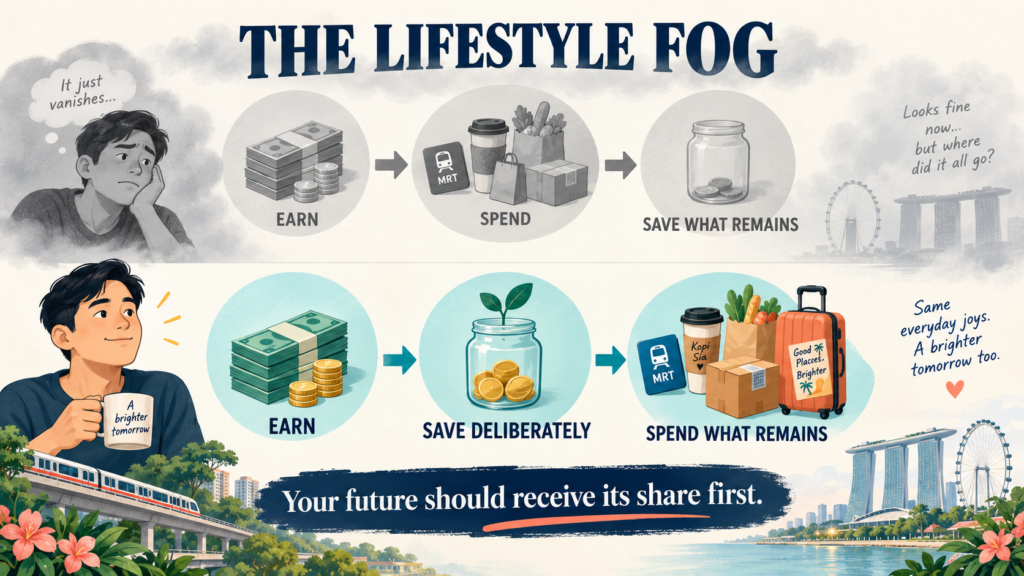
The most common trap is what I call The Lifestyle Fog.
Your salary comes in. Bills are paid. You enjoy a few meals, make several online purchases, book a holiday, and transfer whatever remains into savings.
Nothing looks irresponsible on its own.
That is why the trap is difficult to detect.
The problem is not necessarily that you spend too much on coffee or food. The problem is that every dollar is allowed to compete for your attention before your financial future receives its share.
Most people follow this sequence:
Earn, spend, then save what remains.
People who accumulate wealth more consistently reverse the final two actions:
Earn, save deliberately, then spend what remains.
The difference sounds small. Over several years, it can determine whether you reach $100,000 or merely keep thinking about it.
2. What I Learned From Watching Money Disappear
I have seen how easy it is to mistake a higher income for financial progress.
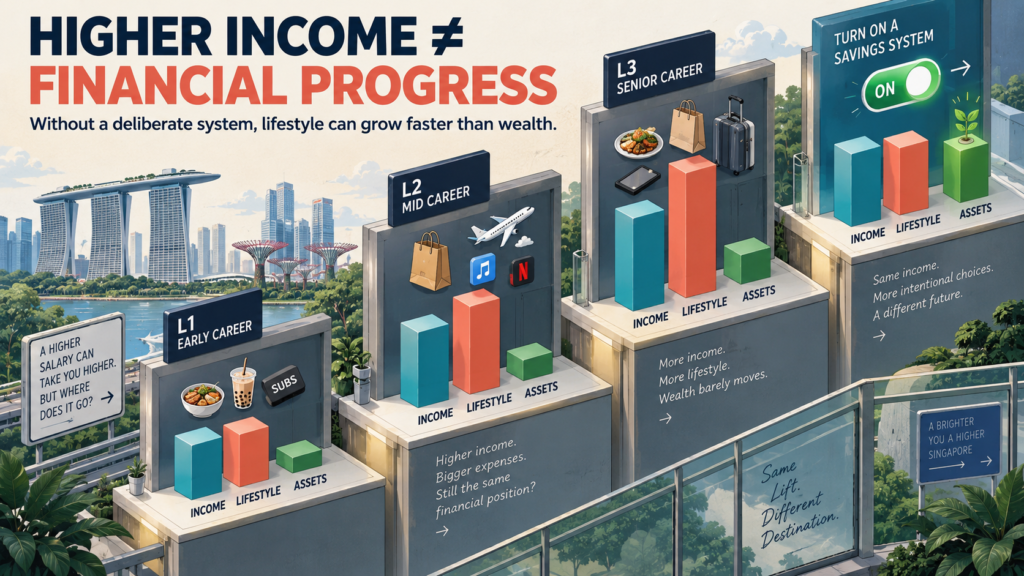
When more money comes in, life quietly expands to absorb it. Meals become more expensive. Holidays become more frequent. Subscriptions accumulate. Purchases that once required careful thought begin to feel normal.
Nothing feels excessive because each decision appears affordable.
But affordability is not the same as progress.
The lesson is uncomfortable but useful: if income increases without a deliberate savings system, lifestyle often grows faster than wealth.
3. The Reframing Rule
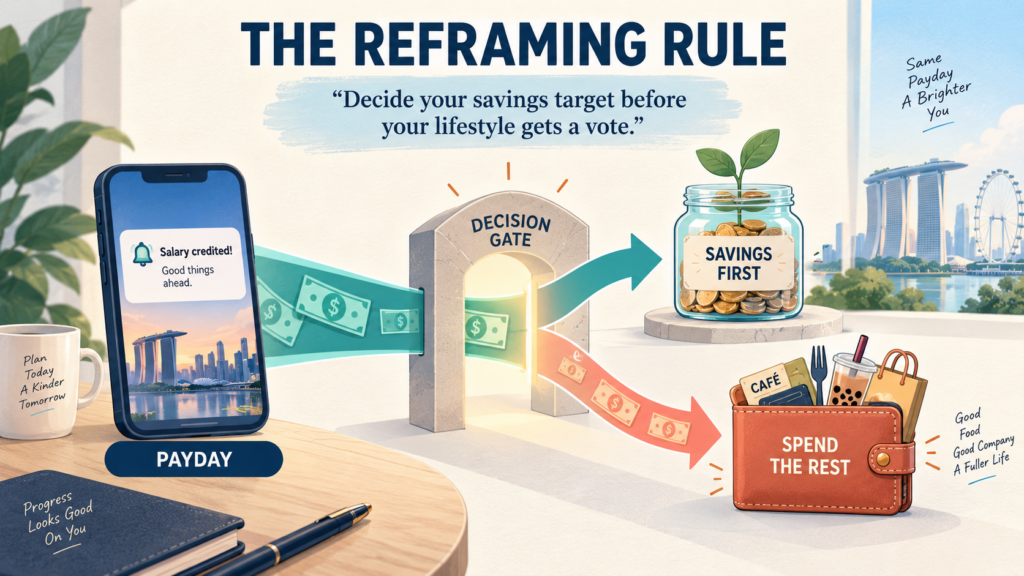
Use this rule whenever you receive income:
Your savings target must be decided before your lifestyle gets a vote.
This does not mean living miserably.
It means deciding what matters first, then enjoying the rest without guilt.
4. The Correct Order of Operations
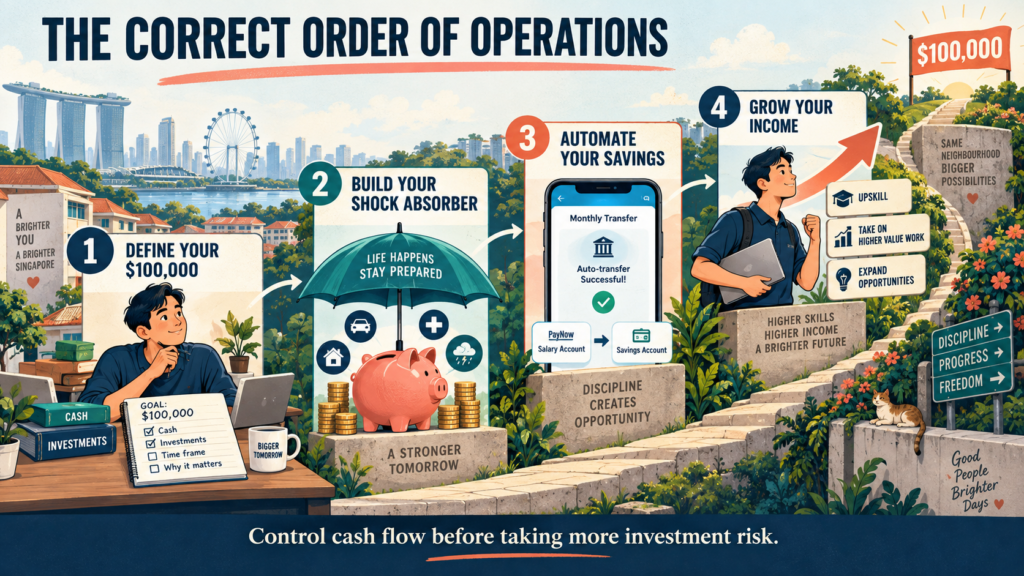
The order matters because each step supports the next one. Investing before controlling your cash flow creates inconsistency. Saving aggressively without an emergency reserve can force you to sell investments when life goes wrong.
Here is the sequence.
Step 1: Define What Counts as Your $100,000
Decide exactly what you are measuring.
Your target could include:
- Cash savings
- Fixed deposits
- Singapore Savings Bonds
- Money market funds
- Investment portfolios
- Other liquid financial assets
You may choose to exclude CPF because CPF serves important housing, healthcare, and retirement purposes and cannot always be used freely.
You may also exclude your car and the home you live in. These assets may have value, but they do not function like accessible capital.
There is no universal definition that everyone must follow. What matters is consistency.
Write down your definition:
My first $100,000 means $100,000 in cash and investments, excluding CPF and the home I live in.
Now calculate your current position.
If you have $28,000 today, your actual target is not $100,000.
Your remaining gap is $72,000.
That is the number your plan needs to solve.
Step 2: Build Your Financial Shock Absorber
Before trying to maximise investment returns, protect yourself from being pushed backwards.
Build an emergency reserve that can cover several months of essential expenses. The appropriate amount depends on your employment stability, family responsibilities, health, insurance coverage, and access to other resources.
This step may sound boring, so I call it your Financial Shock Absorber.
Its purpose is not to generate exciting returns. Its purpose is to stop an unexpected expense, job interruption, or family emergency from destroying the rest of your plan.
Keep this money accessible and relatively stable.
Once the reserve is adequately funded, new savings can be directed towards longer term assets.
Step 3: Automate Your Wealth Conversion
Choose a fixed amount to transfer every month immediately after your salary arrives.
Not at the end of the month.
Not when you remember.
Not after checking whether this month feels expensive.
Immediately.
For example, suppose your take home income is $5,000 and you decide to direct $1,500 towards your goal. Set up the transfers shortly after payday.
The money can be divided between your emergency reserve and investment portfolio according to your needs.
This turns saving from a monthly decision into a default action.
If $1,500 feels impossible, start with an amount you can sustain. Then schedule regular increases.
You could raise the amount whenever:
- Your salary increases
- You receive a bonus
- A loan is repaid
- A recurring expense ends
- Your income from commissions or side projects grows
A useful approach is to save part of every income increase before becoming accustomed to spending it.
Step 4: Attack the Income Side
There is a limit to how much you can cut from your expenses.
There is no equivalent fixed limit on how much your income can grow.
This means your plan should eventually include both expense management and income development.
Consider how you could:
- Negotiate for better compensation
- Build a valuable professional skill
- Pursue a promotion
- Increase your commissions
- Develop a responsible side income
- Turn unused assets or expertise into revenue
Then direct a meaningful portion of the additional income towards your $100,000 target.
If you earn an extra $500 and spend all of it, your lifestyle improves.
If you save all $500, your goal accelerates but life may feel restrictive.
If you save $350 and enjoy $150, you improve both your present and your future.
The objective is not deprivation. It is intentional allocation.
5. The Truth About Investment Returns
Many people believe the fastest way to reach $100,000 is to find an investment with spectacular returns.
That belief can make them vulnerable to concentrated bets, speculative products, market timing, and promises that sound more certain than they really are.
Here is the counterintuitive truth:
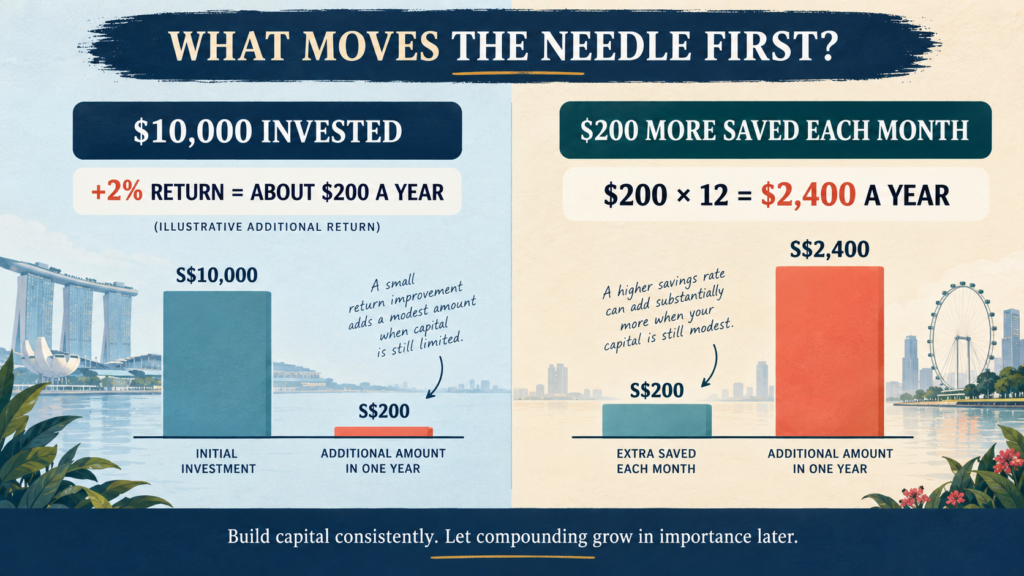
Before you accumulate substantial capital, your savings rate usually matters more than small differences in investment returns.
Suppose you have $10,000 invested.
An additional return of 2 per cent produces approximately $200 during the year.
Finding another $200 of monthly savings produces $2,400 over the same period, before considering any investment growth.
This does not mean returns are unimportant.
It means you should focus first on the lever that you can control most directly.
Build capital consistently. Invest according to an appropriate plan. Allow compounding to become more powerful as the balance grows.
Trying to force high returns before building sufficient capital often introduces more risk than progress.
6. You Versus Your Friend
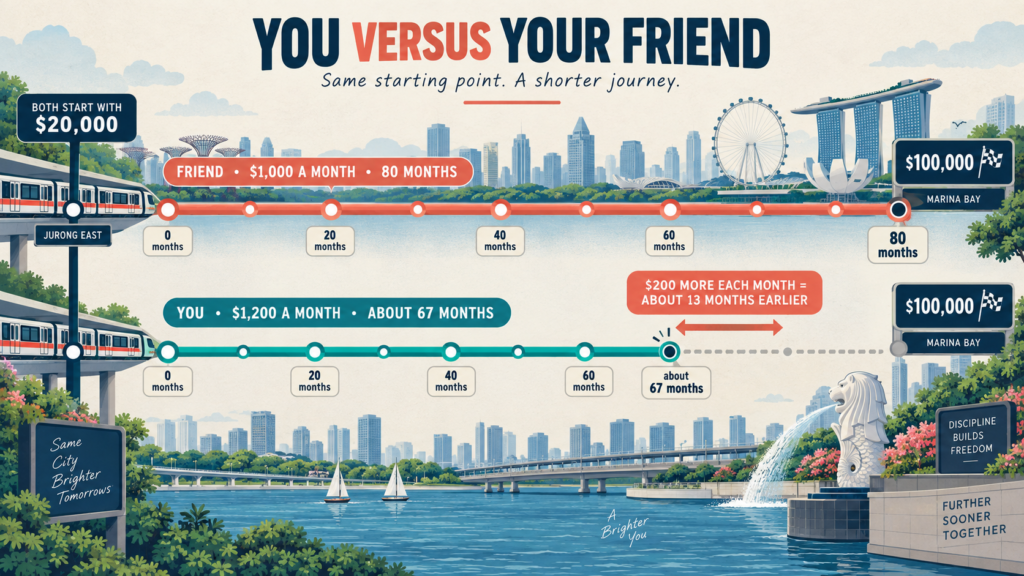
Imagine that you and a friend both want to accumulate $100,000.
You both begin with $20,000.
Your friend saves $1,000 each month. You save $1,200.
The difference is only $200 a month.
Without counting investment returns, your friend needs 80 months to close the remaining $80,000 gap.
You need about 67 months.
That small monthly difference allows you to arrive roughly 13 months earlier.
Now imagine that you increase your contribution whenever your income rises while your friend allows each salary increase to disappear into a more expensive lifestyle.
The difference grows further.
This is why small recurring improvements are powerful. A single $200 decision may not feel significant. A repeated $200 decision changes the timeline.

7. Give Every Bonus a Job
Bonuses and irregular income can dramatically accelerate your progress because they are not always required for monthly living expenses.
Before the money arrives, decide how it will be allocated.
For example:
- 60 per cent towards your $100,000 goal
- 20 per cent towards known future expenses
- 20 per cent for enjoyment
The exact percentages can change. The important point is to decide before the money enters your account.
If you wait until it arrives, every possible purchase will begin competing for it.
A $10,000 bonus can disappear through several reasonable decisions. A holiday, a new phone, gifts for the family, a few good meals, and an upgrade at home may each seem affordable.
Individually, none of them destroys your finances.
Together, they may delay your goal by several months.

8. The Pressure You Should Expect
Once you begin saving seriously, you may feel as if everyone else is moving faster than you.
Someone will buy a new car.
Someone will renovate an impressive home.
Someone will post photographs from an expensive holiday.
Someone earning less than you will appear to be living better than you.
You will not see their loan balances, family support, financial anxiety, or lack of savings. You will only see the visible purchase.
That creates emotional friction.
The danger is not that you will consciously abandon your goal. The danger is that you will gradually increase your lifestyle through a series of small decisions that each feel harmless.
You do not have to reject every pleasure. Money is meant to support a meaningful life.
But every dollar can only perform one job at a time.
Before making a purchase that could delay your progress, ask yourself:
Is this worth postponing the freedom my first $100,000 could give me?
That question will not always lead you to spend less.
It will help you spend deliberately.
And deliberate decisions, repeated month after month, are what will take you to your first $100,000 faster.