
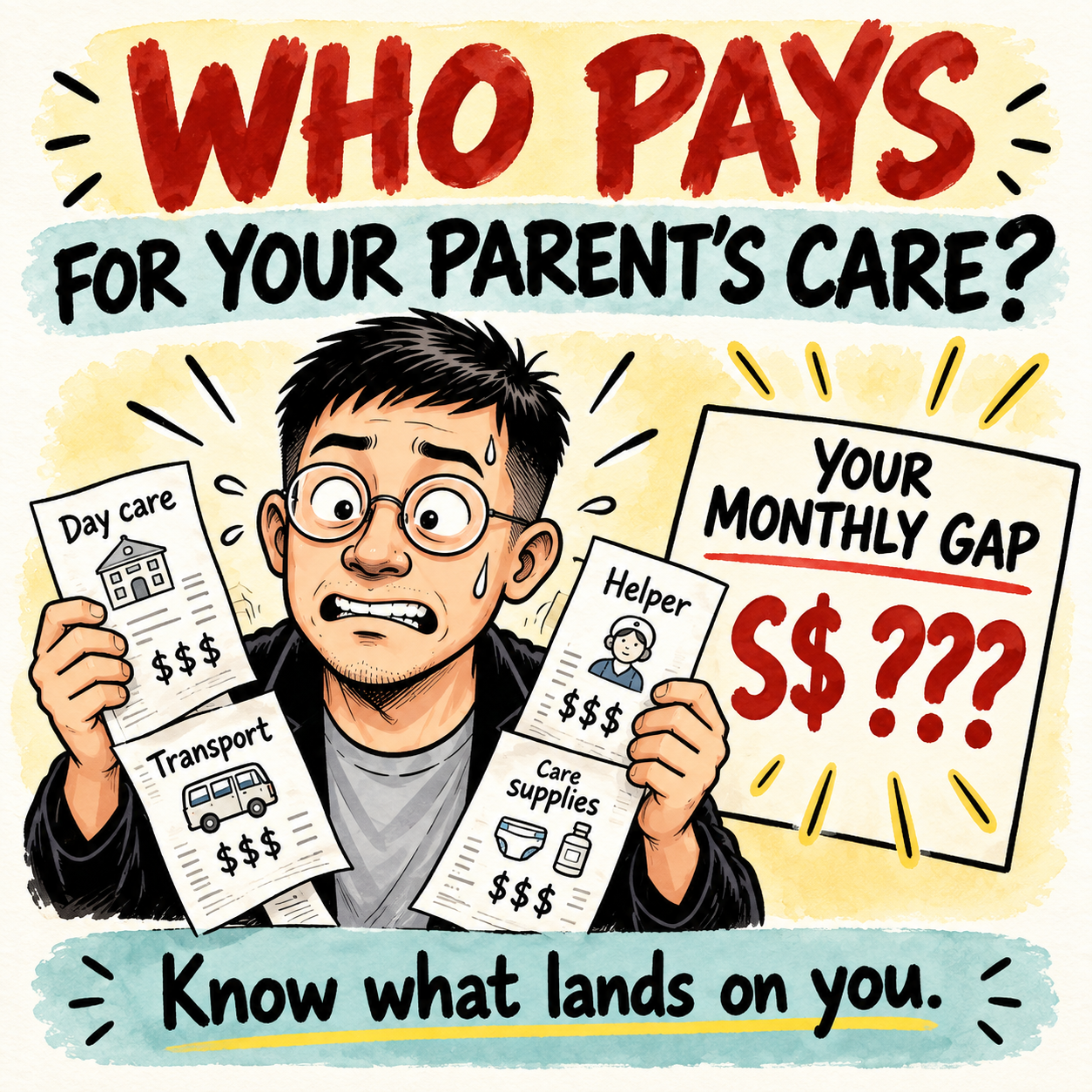
What the national schemes pay, where they stop, and how to find the one number that lands on you.
You already know the bills. The day care centre. The helper’s salary and levy. The taxi to the polyclinic because the MRT is too much for her knees now. The adult diapers that cost more than you expected.
You pay them every month. You tell yourself you will sit down one weekend and work out the full picture.
That weekend rarely comes.
You are not careless. You are carrying two lives at once, your own and your parent’s. Nobody sat you down to show you how the pieces fit. So this article does that. It walks through what the schemes pay, what they were built to do, and how to find the number that matters most to you: your monthly gap.
Here is the hidden truth
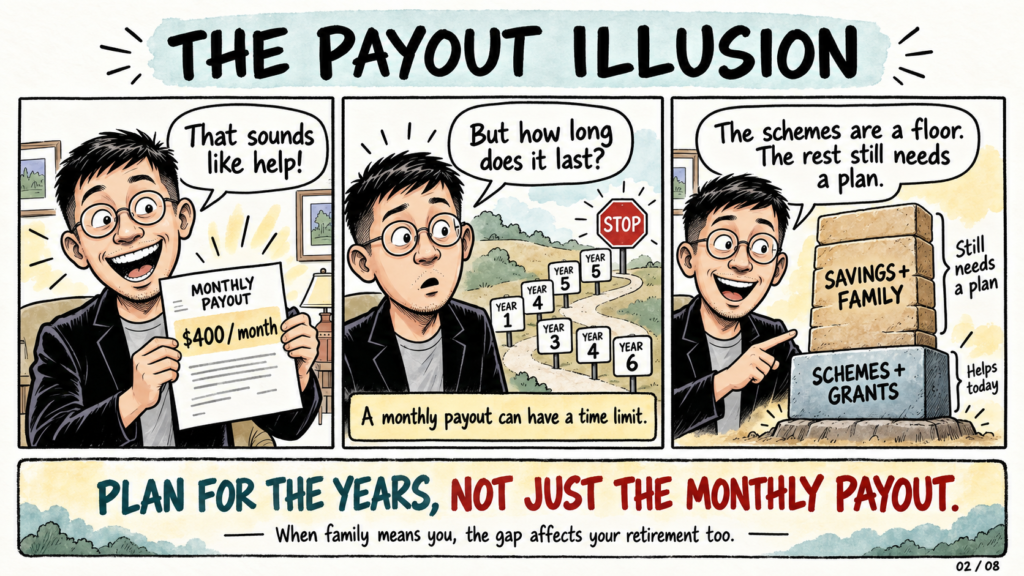
The schemes were built as a floor. They were never meant to be the whole plan.
ElderShield, CareShield Life and the Home Caregiving Grant all help. Each one assumes something fills the space above it: savings, family, or both. When you are the only child, or the only child still in Singapore, or the only one who answers the phone, “family” means you.
Get this right and you can plan your parent’s care and your own retirement side by side. Get it wrong and you find out in year six or seven, when a payout stops and your own savings start to drain.
The trap: the payout illusion
A family hears “$400 a month” and relaxes. The number sounds like help, and it is help.
The illusion is that the payout sets the pace of the plan. It does not. The years set the pace. A modest monthly gap over a long stretch becomes a large total, and it arrives while you are also trying to fund your own retirement.
I call it the payout illusion because the monthly figure is easy to remember and the time limit is easy to miss.
What advisers often see
One pattern comes up again and again in planning conversations with people who support a parent.
The carer knows every bill by heart. The helper’s pay date. The pharmacy total. The price of the good diapers against the cheap ones. Yet very few have added those bills up into one monthly figure, and fewer still have multiplied it by the years.
The reason is rarely money. It is time and energy. When you spend your weekends on appointments, a spreadsheet feels like one more chore.
What changes the conversation is the moment the number goes on paper. The worry has a size. Siblings can see it. Decisions become easier because everyone is looking at the same figure.
The rule
Plan for the years, not the monthly payout.
The four steps, in order
The order matters. You cannot find your gap until you know what the scheme pays and what the grant adds. Skip ahead and you end up guessing at the one number you most need to know.
Step 1: Know what your parent’s scheme pays
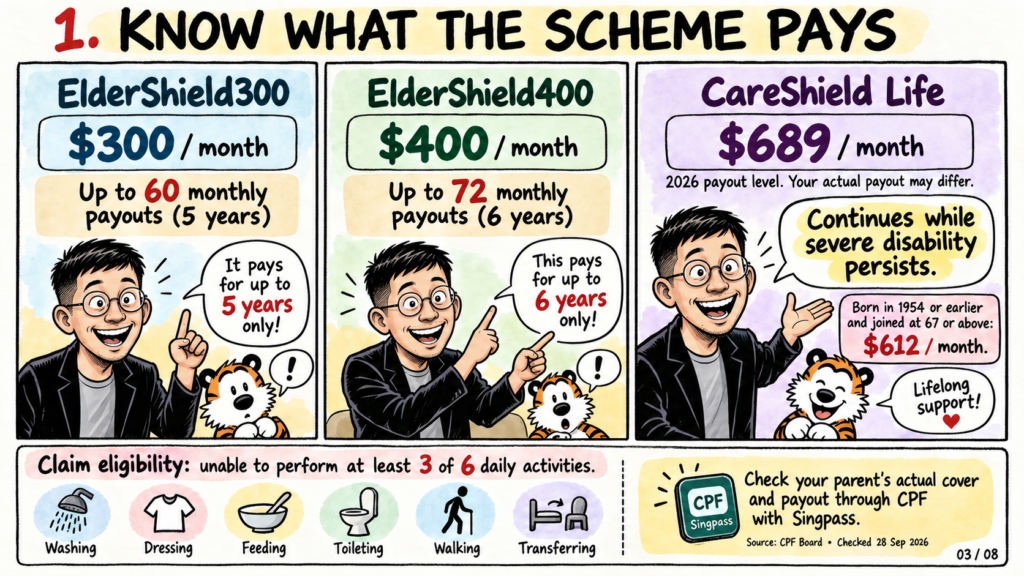
Many parents of today’s 40 and 50 year olds are covered by ElderShield. It comes in two versions, according to the CPF Board:
ElderShield300 pays $300 a month for up to 60 months, or 5 years.
ElderShield400 pays $400 a month for up to 72 months, or 6 years.
Read the second half of each line again. The payout has a cap. After 5 or 6 years it stops, even if your parent still needs care.
CareShield Life works differently. Its monthly payout is $689 in 2026. It keeps paying for as long as the person cannot perform 3 or more of 6 activities of daily living: washing, dressing, feeding, toileting, walking or moving around, and transferring. For members born in 1954 or earlier who joined at age 67 or above, the payout is fixed at $612 a month once a claim succeeds.
Your parent can check which scheme they are on by logging in to the CPF website with Singpass. Do it together. It takes a few minutes and removes the biggest unknown in the whole exercise.
Step 2: Check the grant for care at home
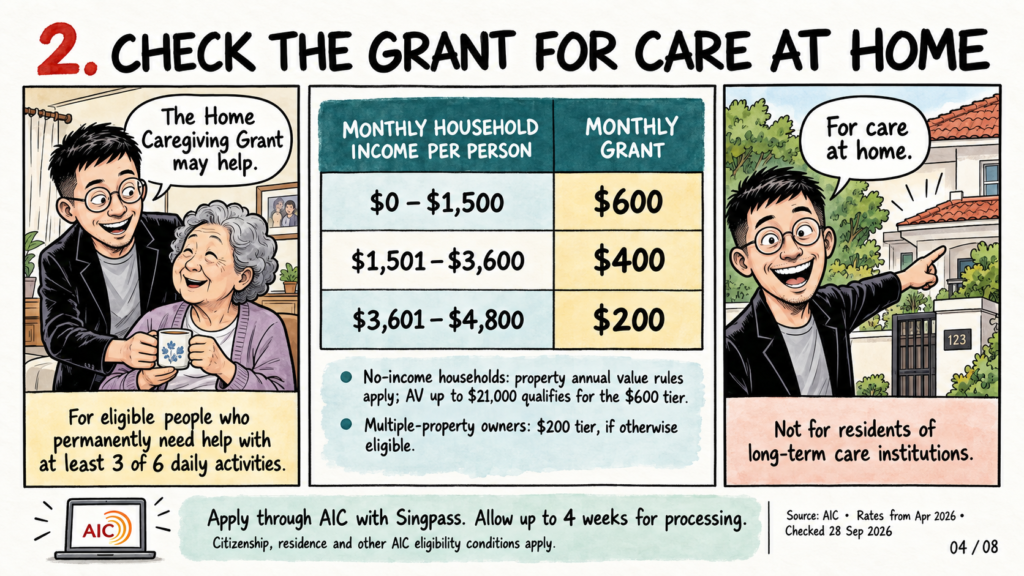
If your parent lives at home and permanently needs help with at least 3 of 6 daily activities, the Home Caregiving Grant may apply. It is means tested on monthly household income per person:
Household income per person Grant per month
$1,500 or less $600
$1,501 to $3,600 $400
$3,601 to $4,800 $200
The Agency for Integrated Care assesses eligibility. You can apply online with Singpass. Processing takes up to four weeks, and payouts start the month after approval.
Notice what the grant assumes. It supports care at home. It does not apply to someone living in a nursing home, and it is designed around a family carer who is already there.
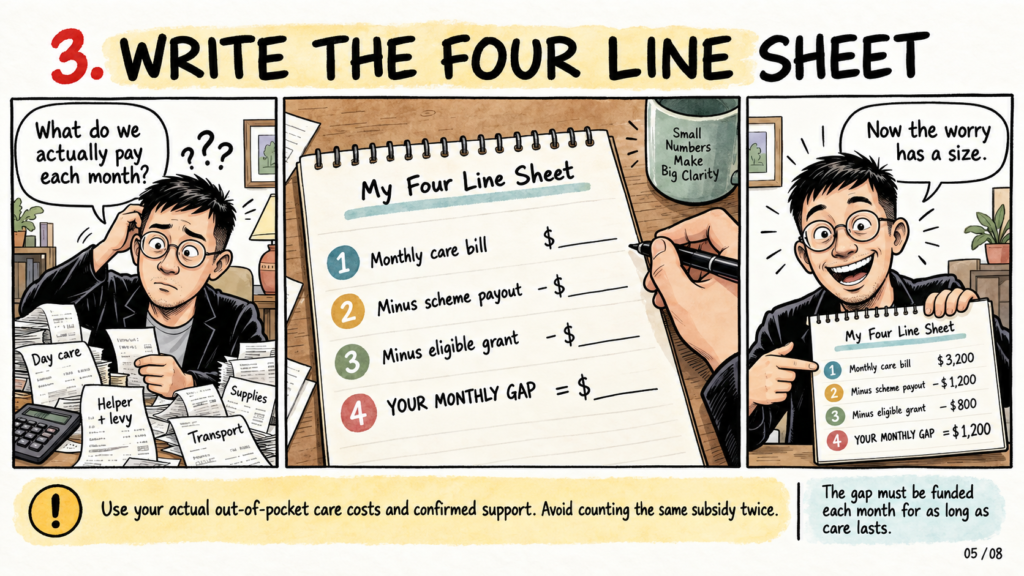
Step 3: The Four Line Sheet
This is the step that does the work, so it gets a name. Take a sheet of paper and write four lines.
Your parent’s monthly care bill: everything you pay for their care in a normal month.
Minus the scheme payout from Step 1.
Minus the grant from Step 2, if it applies.
The result is your monthly gap.
That gap leaves your account every month for as long as care lasts.
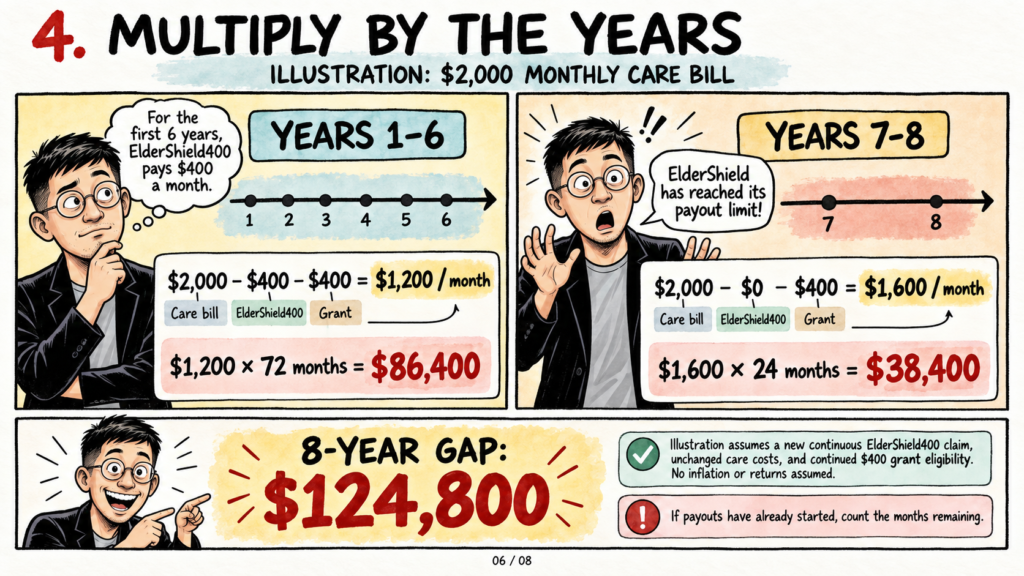
Step 4: Multiply by the years
Now multiply the gap by the years of care you expect. Then check where a payout stops inside those years.
Here is a worked example. The care bill is an assumption for illustration only. The scheme and grant figures are the ones above.
Care bill: say $2,000 a month.
Scheme: ElderShield400, $400 a month for 6 years.
Grant: $400 a month, for a household in the middle income tier.
Years 1 to 6: $2,000 minus $400 minus $400 leaves a gap of $1,200 a month. Over 72 months that is $86,400.
Years 7 and 8: the ElderShield payout has stopped. The gap rises to $1,600 a month. Over 24 months that is $38,400.
Total over 8 years: $124,800.
Your numbers will differ. The shape usually does not. The gap steps up the month the payout ends.
One myth to drop
Myth: “The scheme pays for as long as my parent needs care.”
Fact: ElderShield stops after 60 or 72 monthly payouts, however long the disability lasts. CareShield Life does keep paying while the person stays severely disabled, and $689 a month is still a floor under a bill that is often much larger. Either way, the scheme sets a starting point. You set the plan.
You versus a friend
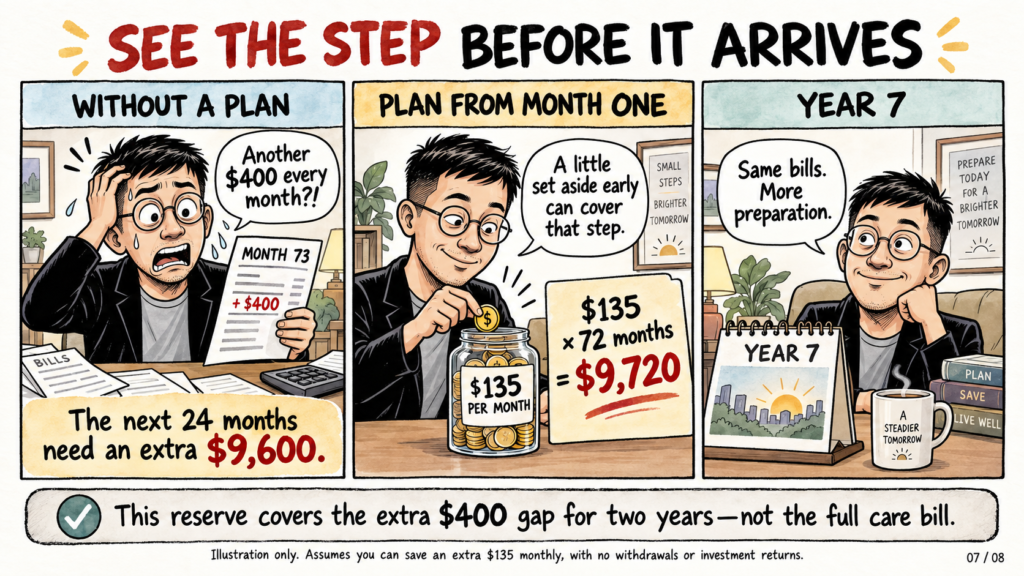
Picture you and a friend, each paying for a parent’s care with the same numbers as the example above.
Your friend hears “$400 a month” and stops there. In month 73 the payout ends. Their monthly outflow jumps from $1,200 to $1,600 with no warning, and the extra $9,600 over the next two years comes out of their own retirement savings.
You write the Four Line Sheet in month one. You see the step coming, and you set aside $135 a month from the start. By month 73 you have $9,720 put away, enough to cover the step for two years. No returns assumed. No new income needed.
Same parent. Same bills. A small change made early, and one of you meets year seven calm.
What this will feel like
Writing the gap down is uncomfortable. The total can look large, and you may feel guilty putting a price on your parent’s care. If you have siblings, raising it can feel like starting an argument.
Push through it. A written number starts a better conversation than a quiet sense of unfairness. And it is the only way to see the step before it arrives.
If you have brothers or sisters, put the sheet in front of them. Agree who pays what, and write that down too. A split that lives only in someone’s memory tends to drift back to the person who lives closest.
Then run the same sheet for yourself. You are paying for someone who once paid for you. At 75, who pays your gap?
So here is the question to sit with: if you do not write this number down this month, what will you have to give up when year seven comes?
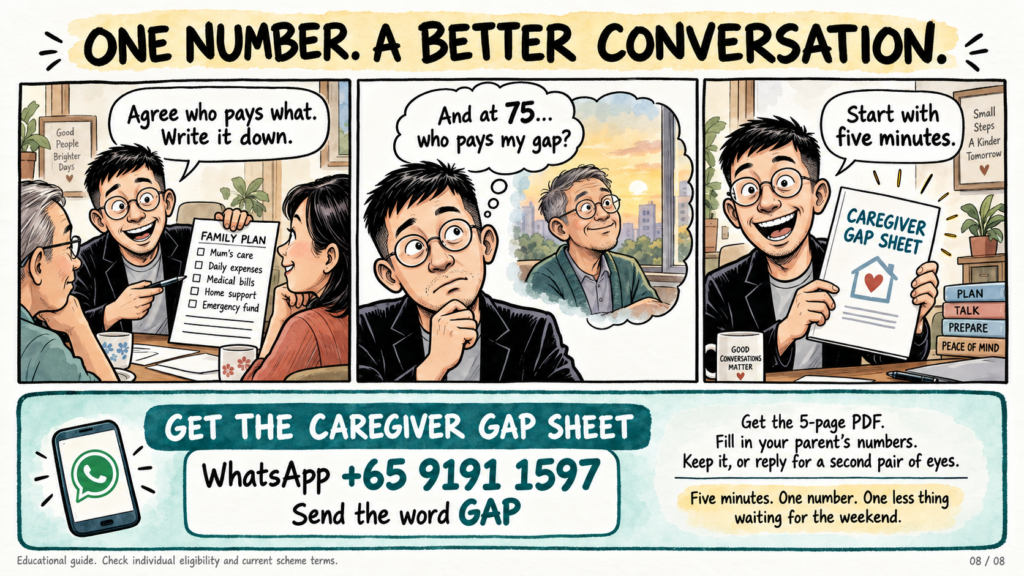
Get the Caregiver Gap Sheet
I built a 5 page sheet that walks you through the four steps above. It lists the scheme payouts and grant tiers in one place, gives you the Four Line Sheet to fill in, and ends with the same sheet for your own future. It takes about five minutes.
Here is how to get it:
WhatsApp +65 9191 1597 with the word GAP.
I send you the sheet as a PDF.
Fill it in with your parent’s numbers. If you want a second pair of eyes on it, reply and we can go through it together. If not, keep the sheet. It is yours.
Five minutes, one number, and one less thing waiting for that weekend that never comes.