
Are you also aiming for the $1m goal?
Most people think nothing changes in their financial life until they hit $1 million dollars.
So they focus entirely on that distant finish line, grinding through stress and completely missing the 4 smaller doors that unlock along the way.
Your financial life doesn’t transform all at once. It changes at 5 distinct math and psychological thresholds:
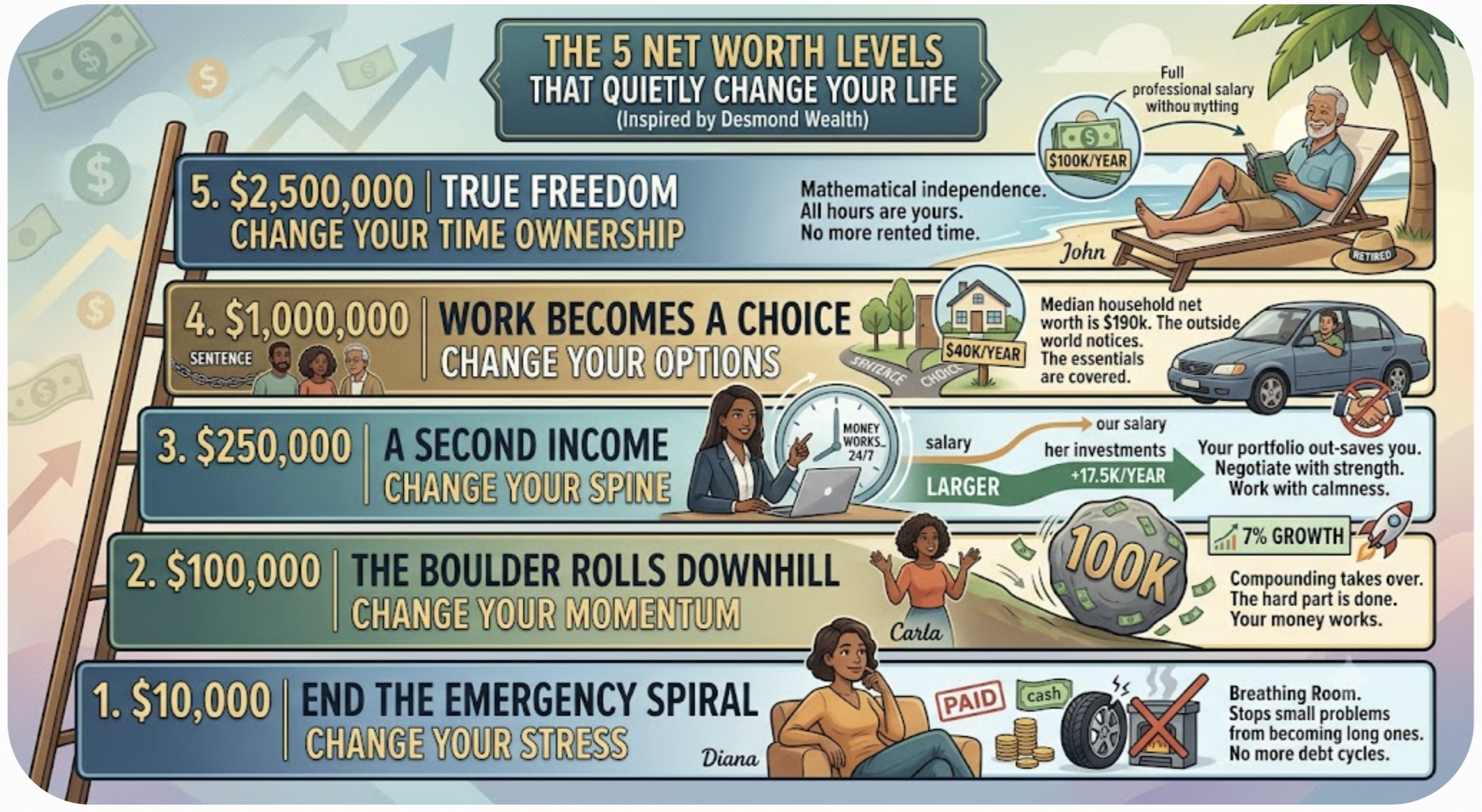
📉 Level 1: $10,000 — Changes your stress. This isn’t wealth; it’s a cushion. It is the wall that stops a bad Tuesday (a minor accident, a dental bill) from turning into a high-interest debt spiral. It shifts you from defensive reaction mode to proactive breathing room.
📈 Level 2: $100,000 — Changes your momentum. As Charlie Munger famously said, the first $100k is a brutal grind because your savings do 95% of the work. But once you cross it, the boulder starts rolling downhill. Compounding finally has enough mass to pull its own weight.
🦁 Level 3: $300,000 — Changes your spine. This is the ultimate underrated threshold. At $300k, a standard 7% market return adds over $21,000 a year. Suddenly, your money is producing a basic liveable income. It gives you the psychological backing to stop tolerating toxic bosses or bad situations out of fear.
🔑 Level 4: $1,000,000 — Changes your options. Investing with 5% dividend, a million dollars yields about $50,000 a year indefinitely—covering basic living essentials for many households. Work stops being a lifetime sentence and officially becomes a choice.
⏳ Level 5: $2,500,000 — Changes your ownership of time. At this stage, based on 4% rule, your portfolio throws off a full professional salary ($100k/year) without touching the principal. You don’t necessarily live a flashier life, but you completely own your calendar.
💡 The Takeaway: If you feel discouraged because you’re far from a million, stop staring at the horizon. Ask yourself: Which line is closest right now?
Don’t run toward the level that impresses other people. Run toward the next level that can make a difference to your life.
Important: The information and opinions in this article are for general information purposes only. They should not be relied on as professional financial advice. Readers should seek unbiased financial advice that is customised to their specific financial objectives, situations & needs. This advertisement or publication has not been reviewed by the Monetary Authority of Singapore.

Published By:
Tan Siak Lim
More than 20 years in the financial advisory business, focus on mainly help people achieve a comfortable retirement through portfolio management, with diversification to reduce the votaility and still achieving the required rate of return.
Also helps wealthy family (>$3m estate, including property, investment and insurance proceeds) pass on their wealth to future generations, minimizing the 3C, confusion, cost, and conflict. Estate planning is probably best done by a qualified experienced financial adviser rather than a lawyer. The lawyer is able to draft a will, but because he is not a financial adviser, he is usually unable to put comprehensive financial consideration into the design of the will. Will drafting is a mechanical process that software can easily generate, there is little value. It is the architecting of a wealth distribution strategy with creative financial products and ideas that is the real value.

CONTACT US
- 150 Beach Road #12-01/08, Gateway West Singapore 189720
- +65 62221889
- +65 62221019
- feedback@fa.com.sg