
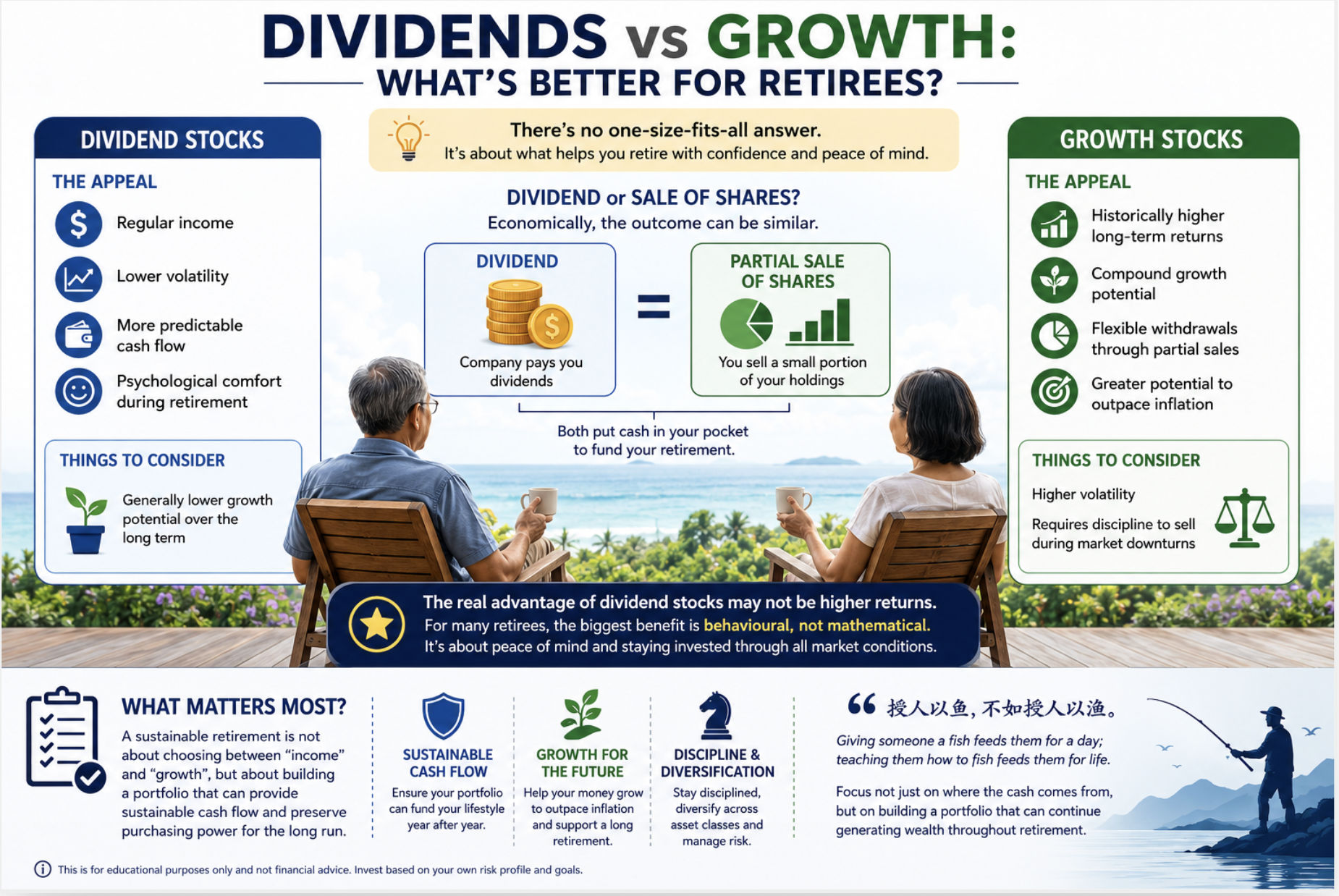
For retirees, is dividend investing really better than growth investing?
Many retirees prefer dividend investing to growth investing to fund retirement, but is it really better?
After all, receiving dividends feels like “living off income” rather than touching capital.
But is that really true?
Let’s consider two investors:
Investor A owns dividend stocks yielding 4% annually.
Investor B owns growth stocks that pay little or no dividend but grow at a faster rate over time, say 10%pa.
If Investor B sells 4% of his portfolio each year to fund retirement, is he worse off? He still keeps 6% as capital gain for compounding.
From a financial perspective, not necessarily.
A dividend payment reduces a company’s value by the amount distributed. In other words, part of the shareholder’s capital is being returned, this is not very different from selling a small portion of a growth portfolio to fund living expenses.
The real advantage of dividend stocks may not be higher returns.
In fact, historically, growth stocks have often delivered higher long-term returns because they reinvest profits back into the business instead of distributing them. And dividend stocks usually has lower return as these are matured companies.
The appeal of dividend stocks lies elsewhere:
✔ Lower volatility (usually but not always)
✔ More predictable cash flow
✔ Psychological comfort and ease during retirement
✔ Less temptation to sell during market downturns
For many retirees, the biggest benefit is behavioural, not mathematical.
Receiving a dividend cheque feels easier than selling shares, even when the economics may be similar.
The danger is becoming so focused on dividends that you sacrifice diversification and growth potential.
Retirement investing is not about choosing between “income” and “growth.”
It’s about building a portfolio that can provide sustainable cash flow while preserving purchasing power for a retirement that could last 30 years or more.
As the Chinese proverb says:
“授人以鱼,不如授人以渔“ — Giving someone a fish feeds them for a day; teaching them how to fish feeds them for life.
Likewise, retirees should focus not just on where the cash comes from, but on building a portfolio that can continue generating sustainable wealth throughout retirement.
What do you think?
Would you rather receive dividends, or are you comfortable selling a small portion of your investments to fund retirement?
Important: The information and opinions in this article are for general information purposes only. They should not be relied on as professional financial advice. Readers should seek unbiased financial advice that is customised to their specific financial objectives, situations & needs. This advertisement or publication has not been reviewed by the Monetary Authority of Singapore.

Published By:
Tan Siak Lim
More than 20 years in the financial advisory business, focus on mainly help people achieve a comfortable retirement through portfolio management, with diversification to reduce the votaility and still achieving the required rate of return.
Also helps wealthy family (>$3m estate, including property, investment and insurance proceeds) pass on their wealth to future generations, minimizing the 3C, confusion, cost, and conflict. Estate planning is probably best done by a qualified experienced financial adviser rather than a lawyer. The lawyer is able to draft a will, but because he is not a financial adviser, he is usually unable to put comprehensive financial consideration into the design of the will. Will drafting is a mechanical process that software can easily generate, there is little value. It is the architecting of a wealth distribution strategy with creative financial products and ideas that is the real value.

CONTACT US
- 150 Beach Road #12-01/08, Gateway West Singapore 189720
- +65 62221889
- +65 62221019
- feedback@fa.com.sg