
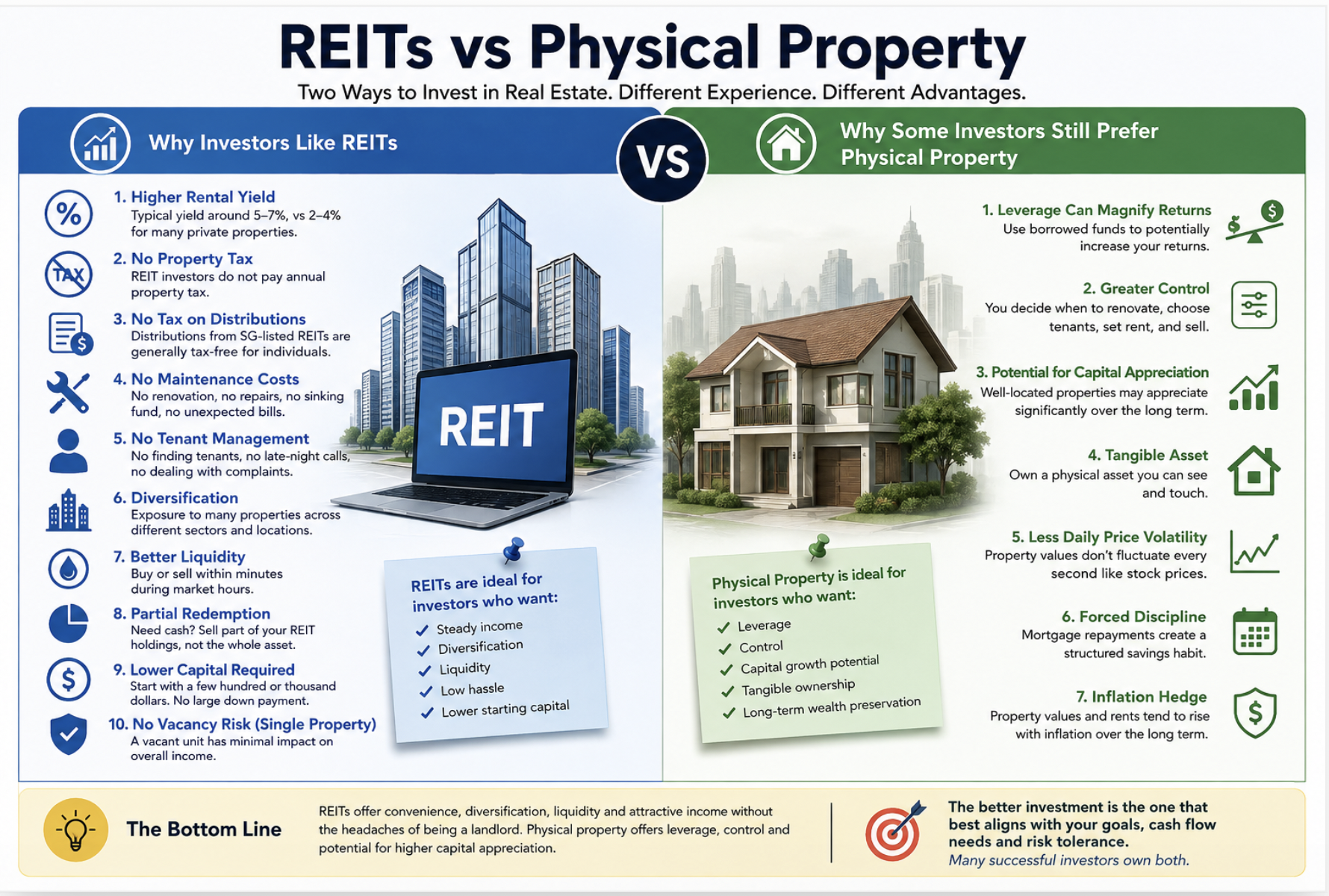
REITs vs Physical Property: Which Is Better?
Many Singaporeans aspire to own investment property. However, listed REITs (Real Estate Investment Trusts) offer an alternative that is often overlooked.
The truth is, neither is universally better. It depends on your objectives, risk tolerance, and investment style.
Why Investors Like REITs
1. Higher Rental Yield
Many Singapore REITs currently provide distribution yields of around 5–7%, compared to around 2–4% gross rental yield for many private residential properties.
2. No Property Tax
REIT investors do not pay annual property tax, unlike owners of investment properties.
3. No Tax on REIT Distributions (Singapore Individuals)
For most individual investors in Singapore, distributions from Singapore-listed REITs are generally received tax-free.
4. No Maintenance Costs
No renovation expenses.
No replacement of air-conditioners.
No leaking pipes.
No sinking fund.
No unexpected repair bills.
5. True passive income
No late-night calls.
No finding tenants.
No negotiating tenancy agreements.
No dealing with complaints or property agents.
6. Diversification
Buying one REIT can give you exposure to dozens or even hundreds of properties across sectors such as:
- Shopping malls
- Offices
- Logistics warehouses
- Data centres
- Hospitals
- Hotels
- Industrial buildings
This reduces concentration risk compared to owning a single apartment.
7. Better Liquidity
Need cash?
You can usually sell your REIT holdings within minutes during market hours, rather than waiting months to sell a property.
8. Partial Redemption
If you need only $30,000, you can simply sell part of your REIT portfolio.
With physical property, you generally cannot sell just one toilet to raise cash.
9. Lower Capital Required
You can start investing with a few hundred or a few thousand dollars instead of needing a large down payment, stamp duties, and legal fees.
10. No Vacancy Risk on a Single Property
A vacant apartment means 100% of that property’s rental income disappears.
REITs own many properties and tenants, so the impact of one vacant unit is usually minimal.
Why Some Investors Still Prefer Physical Property
Despite the advantages of REITs, physical property has its own strengths.
1. Leverage Can Magnify Returns
Banks are generally willing to lend substantial amounts for property purchases.
If prices rise, leverage can significantly enhance your return on equity. But the reserve is also true.
2. Greater Control
You decide:
- When to renovate
- Which tenant to accept
- When to increase rent
- When to sell
You have full control over the asset.
3. Potential for Capital Appreciation
A well-located property may enjoy significant appreciation over the long term due to factors such as land scarcity, redevelopment potential, or infrastructure improvements.
4. Tangible Asset
Many investors appreciate owning something they can see and touch, rather than shares listed on a stock exchange.
5. Less Daily Price Volatility
Property values do not fluctuate every second like stock prices. It still fluctuate, but is less visible.
This can make it psychologically easier for some investors to hold through market cycles.
The Bottom Line
REITs provide convenience, diversification, liquidity, and attractive income without the headaches of being a landlord.
Physical property offers leverage, control, and the potential for significant capital appreciation.
Neither is inherently superior.
The better investment is the one that best aligns with your financial goals, cash flow needs, and risk tolerance. Many successful investors own both, using each to play a different role in their overall wealth strategy.
Important: The information and opinions in this article are for general information purposes only. They should not be relied on as professional financial advice. Readers should seek unbiased financial advice that is customised to their specific financial objectives, situations & needs. This advertisement or publication has not been reviewed by the Monetary Authority of Singapore.

Published By:
Tan Siak Lim
More than 20 years in the financial advisory business, focus on mainly help people achieve a comfortable retirement through portfolio management, with diversification to reduce the votaility and still achieving the required rate of return.
Also helps wealthy family (>$3m estate, including property, investment and insurance proceeds) pass on their wealth to future generations, minimizing the 3C, confusion, cost, and conflict. Estate planning is probably best done by a qualified experienced financial adviser rather than a lawyer. The lawyer is able to draft a will, but because he is not a financial adviser, he is usually unable to put comprehensive financial consideration into the design of the will. Will drafting is a mechanical process that software can easily generate, there is little value. It is the architecting of a wealth distribution strategy with creative financial products and ideas that is the real value.

CONTACT US
- 150 Beach Road #12-01/08, Gateway West Singapore 189720
- +65 62221889
- +65 62221019
- feedback@fa.com.sg