
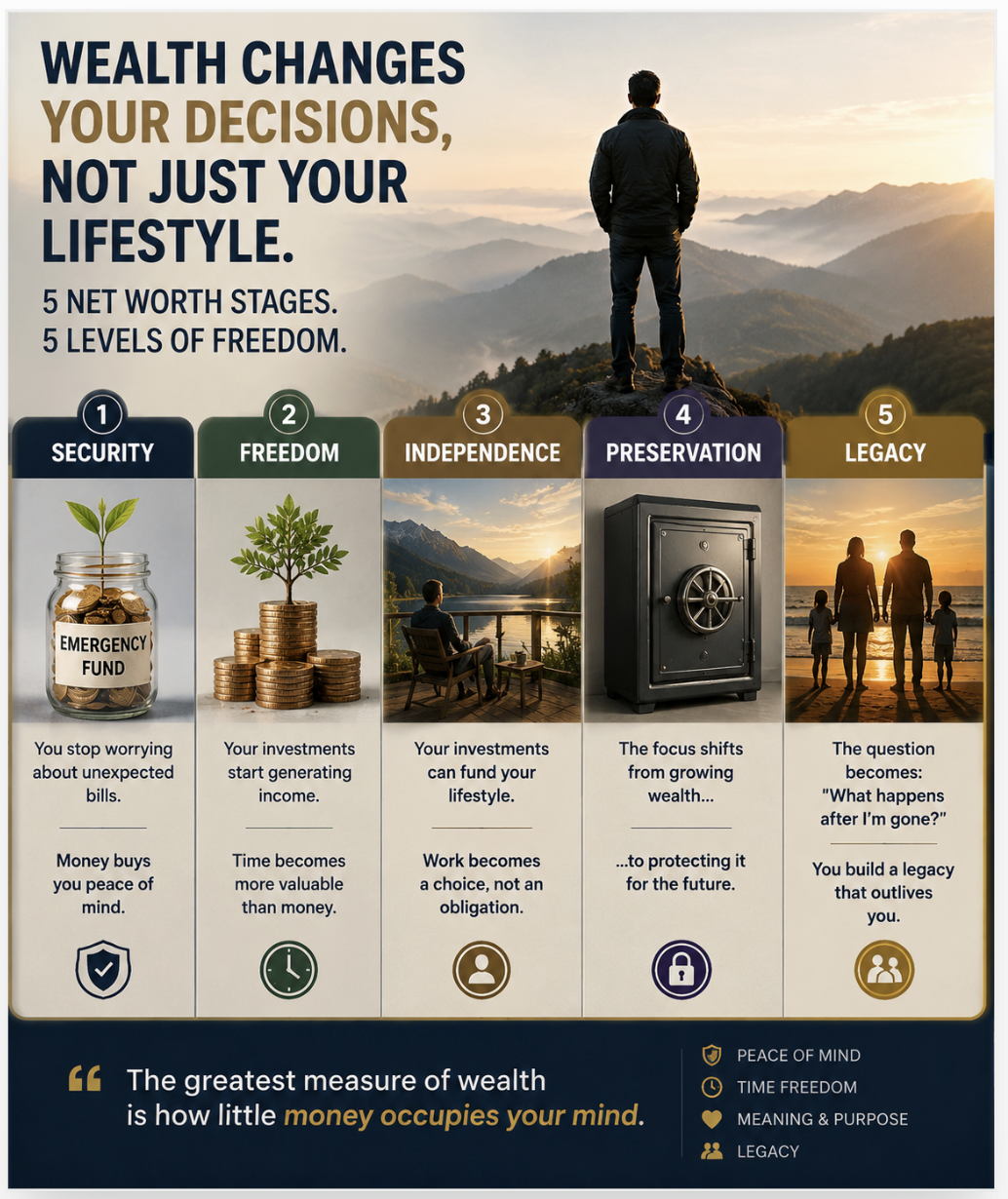
What does being wealthy really means?
Most people think becoming wealthy means buying a bigger house, a nicer car or flying Business Class.
After 20+ years as a financial adviser, I’ve learnt that wealth changes something far more important.
It changes your relationship with money.
I’ve noticed five distinct stages.
Stage 1: Security
You no longer panic when life throws you an unexpected expense.
A medical bill. A retrenchment. A major home repair.
They’re inconveniences, not disasters.
Money starts buying peace of mind.
Stage 2: Freedom
Your investments begin generating enough income that you’re no longer relying solely on your monthly salary.
Money starts working while you sleep.
For the first time, you realise time is becoming more valuable than money.
Stage 3: Independence
This is my favourite milestone.
Your investments can support the lifestyle you want.
You don’t have to work.
You choose to work.
That’s a profound difference.
When work becomes optional, you’re free to say “no” to the projects, clients or employers that no longer align with your values.
Stage 4: Preservation
This is where many affluent families change their mindset.
The question is no longer:
“How do I earn a higher return?”
It becomes:
“How do I make sure I don’t lose what I’ve spent decades building?”
Protecting your retirement from a major market decline.
Managing sequence-of-returns risk.
Planning for healthcare costs.
Structuring your estate properly.
At this stage, avoiding catastrophic mistakes is often worth more than chasing an extra 1% return.
Stage 5: Legacy
Eventually, the focus shifts away from yourself.
The real question becomes:
“What happens to everything I’ve built when I’m no longer here?”
A will.
A trust.
CPF nominations.
Insurance.
A Letter of Wishes.
These aren’t just legal documents.
They’re the final chapter of your financial plan.
I’ve met people worth more than $10 million who still worried every day about money.
I’ve also met retirees with far less who slept peacefully every night.
The difference wasn’t the size of their portfolio.
It was knowing they had enough.
Perhaps the greatest measure of wealth isn’t how much you own.
It’s how little money occupies your mind.
Which stage do you think you’re in today?
#FinancialPlanning #RetirementPlanning #WealthPreservation #EstatePlanning #FinancialIndependence #Investing #Singapore #PersonalFinance
Important: The information and opinions in this article are for general information purposes only. They should not be relied on as professional financial advice. Readers should seek unbiased financial advice that is customised to their specific financial objectives, situations & needs. This advertisement or publication has not been reviewed by the Monetary Authority of Singapore.
Published By:
Tan Siak Lim
More than 20 years in the financial advisory business, focus on mainly help people achieve a comfortable retirement through portfolio management, with diversification to reduce the votaility and still achieving the required rate of return.
Also helps wealthy family (>$3m estate, including property, investment and insurance proceeds) pass on their wealth to future generations, minimizing the 3C, confusion, cost, and conflict. Estate planning is probably best done by a qualified experienced financial adviser rather than a lawyer. The lawyer is able to draft a will, but because he is not a financial adviser, he is usually unable to put comprehensive financial consideration into the design of the will. Will drafting is a mechanical process that software can easily generate, there is little value. It is the architecting of a wealth distribution strategy with creative financial products and ideas that is the real value.
CONTACT US
- 150 Beach Road #12-01/08, Gateway West Singapore 189720
- +65 62221889
- +65 62221019
- feedback@fa.com.sg