
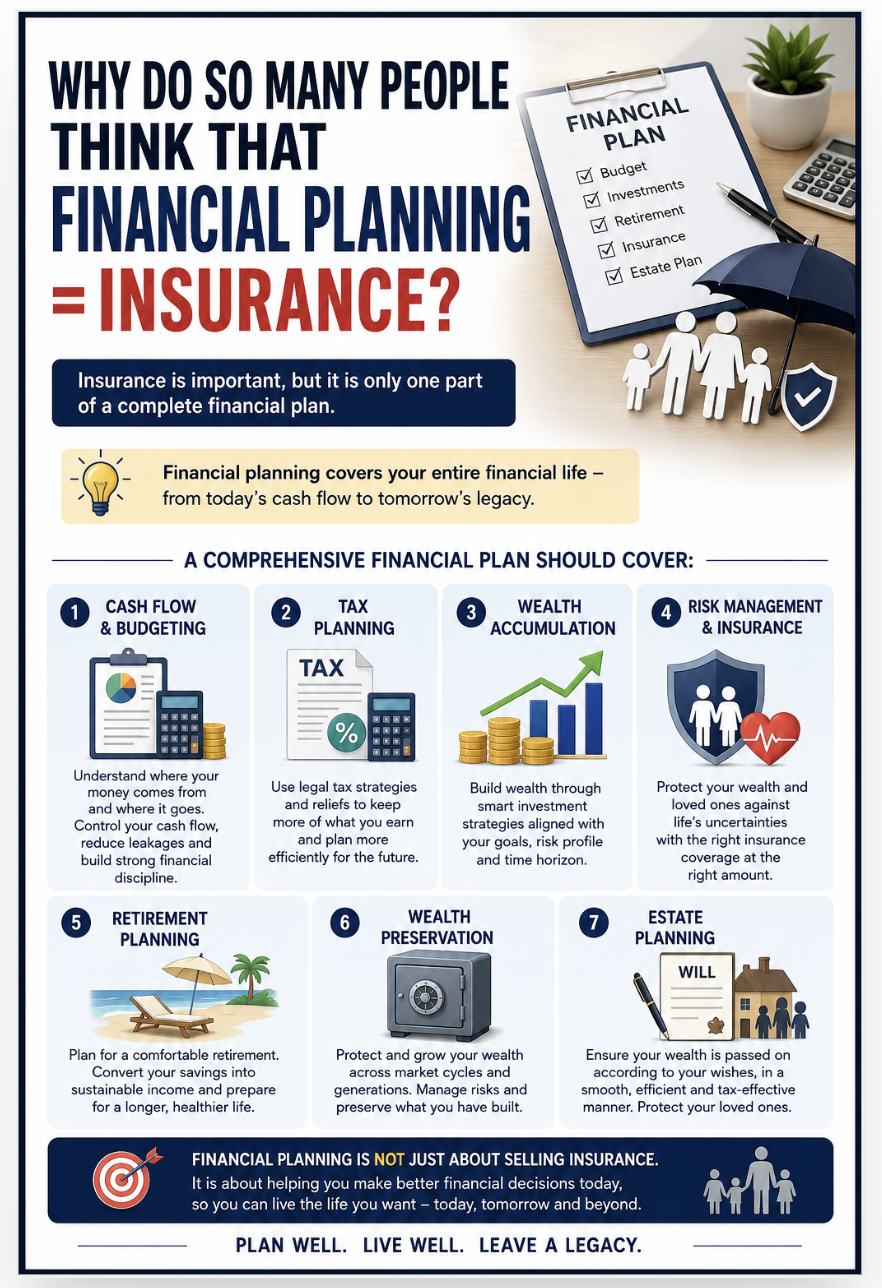
Why do so many people think financial planning = insurance?
I often hear people say:
“I already have a financial planner.”
Then, after a little conversation, I realise what they actually mean is:
“I have an insurance agent.”
When a client ask for help to review his financial plan, he brings nothing except a stack of insurance policies!!
Perhaps one reason is that many insurance agents today use titles such as Financial Consultant, Financial Adviser or Financial Planner.
There is nothing inherently wrong with that.
But financial planning is much broader than insurance planning.
Insurance is only one component of a proper financial plan.
A comprehensive financial plan should look at the entire financial life of an individual or family — from how money is managed today, to how wealth is accumulated, converted into retirement income, protected and eventually transferred to the next generation.
Here are the major areas I believe financial planning should cover:
1. Cash Flow & Budgeting
Before talking about investments or insurance, we need to understand where the money is going.
How much is coming in?
How much is being spent?
How much is being saved?
Are there unnecessary leakages?
A person earning $300,000 a year but spending $290,000 may actually be in a weaker financial position than someone earning $150,000 and consistently saving $50,000.
Good financial planning starts with financial discipline.
2. Tax Planning
Taxes can significantly affect how much wealth a person ultimately retains.
Tax planning isn’t simply about “paying less tax”.
It is about understanding the available tax structures, deductions, reliefs and investment implications, and making decisions that are tax-efficient within the rules.
For high-income individuals and business owners, this can become increasingly important as wealth grows.
3. Wealth Accumulation
Once the foundation is sound, the next question is:
How do we grow the money?
This involves determining:
- Investment objectives
- Risk capacity and risk tolerance
- Asset allocation
- Diversification
- Investment time horizon
- Expected returns
- Liquidity requirements
The objective isn’t to find the investment that gives the highest return.
It is to build an investment strategy that gives the client a reasonable probability of achieving their financial objectives without taking unnecessary risk.
4. Risk Management & Insurance
This is where insurance comes in.
Insurance is important because wealth accumulation can be destroyed very quickly by an unexpected event.
Death.
Disability.
Critical illness.
Long-term care needs.
A proper insurance review should determine what risks actually need to be transferred to an insurer, how much coverage is appropriate, and whether the existing policies are still relevant.
Insurance should serve the financial plan.
The financial plan should not be built simply to sell insurance.
5. Retirement Planning
Accumulating $3 million is one problem.
Knowing how to turn that $3 million into sustainable retirement income is another.
Retirement planning should consider:
- How much is needed to maintain the desired lifestyle
- CPF and CPF LIFE
- Investment income
- Withdrawal strategy
- Inflation
- Longevity risk
- Healthcare costs
- Market volatility
- Sequence-of-returns risk
- Legacy objectives
The critical question isn’t:
“How much money do I have?”
It is:
“Can this money reliably support the life I want for the rest of my life?”
6. Wealth Preservation
Once someone has accumulated substantial wealth, the objective can change.
During the accumulation phase, the focus may be on growing wealth.
As retirement approaches, the priority may shift towards protecting wealth and managing downside risk.
This doesn’t mean avoiding all investment risk.
It means taking the right amount of risk for the stage of life you are in.
You don’t necessarily need the highest possible return.
You need a portfolio that allows you to sleep well while still achieving your objectives.
7. Estate Planning
Finally, what happens to the wealth when you are no longer around?
This is where estate planning comes in.
A comprehensive estate plan may involve:
- Will
- CPF nomination
- Insurance nomination
- Lasting Power of Attorney
- Trust structures
- Business succession
- Distribution of assets
- Liquidity planning
- Protection of beneficiaries
Because inheritance is not merely about who gets the money.
It is also about when they receive it, how they receive it, and whether they are capable of managing it.
A $2 million inheritance can be a tremendous blessing.
But without proper planning, it can also create family disputes, poor financial decisions, or unintended consequences.
So, is insurance part of financial planning?
Absolutely.
But saying financial planning = insurance is like saying:
“Healthcare = medicine.”
Medicine is part of healthcare.
But healthcare is much bigger than medicine.
Likewise, insurance is an important component of financial planning — but financial planning encompasses the entire financial journey.
From managing today’s cash flow → accumulating wealth → protecting wealth → generating retirement income → preserving wealth → transferring wealth.
That is what comprehensive financial planning should look like.
大道至简.
The best financial plan isn’t necessarily the most complicated one.
It is the one that connects all the pieces and answers one fundamental question:
“Will my money do what I need it to do — throughout my lifetime and beyond?”
What does financial planning mean to you — insurance, investments, retirement, or the whole picture?
#FinancialPlanning #WealthManagement #RetirementPlanning #EstatePlanning #WealthPreservation #InsurancePlanning #SingaporeFinance #FinancialAdviser #CPF #Retirement
Important: The information and opinions in this article are for general information purposes only. They should not be relied on as professional financial advice. Readers should seek unbiased financial advice that is customised to their specific financial objectives, situations & needs. This advertisement or publication has not been reviewed by the Monetary Authority of Singapore.

Published By:
Tan Siak Lim
More than 20 years in the financial advisory business, focus on mainly help people achieve a comfortable retirement through portfolio management, with diversification to reduce the votaility and still achieving the required rate of return.
Also helps wealthy family (>$3m estate, including property, investment and insurance proceeds) pass on their wealth to future generations, minimizing the 3C, confusion, cost, and conflict. Estate planning is probably best done by a qualified experienced financial adviser rather than a lawyer. The lawyer is able to draft a will, but because he is not a financial adviser, he is usually unable to put comprehensive financial consideration into the design of the will. Will drafting is a mechanical process that software can easily generate, there is little value. It is the architecting of a wealth distribution strategy with creative financial products and ideas that is the real value.
CONTACT US
- 150 Beach Road #12-01/08, Gateway West Singapore 189720
- +65 62221889
- +65 62221019
- feedback@fa.com.sg