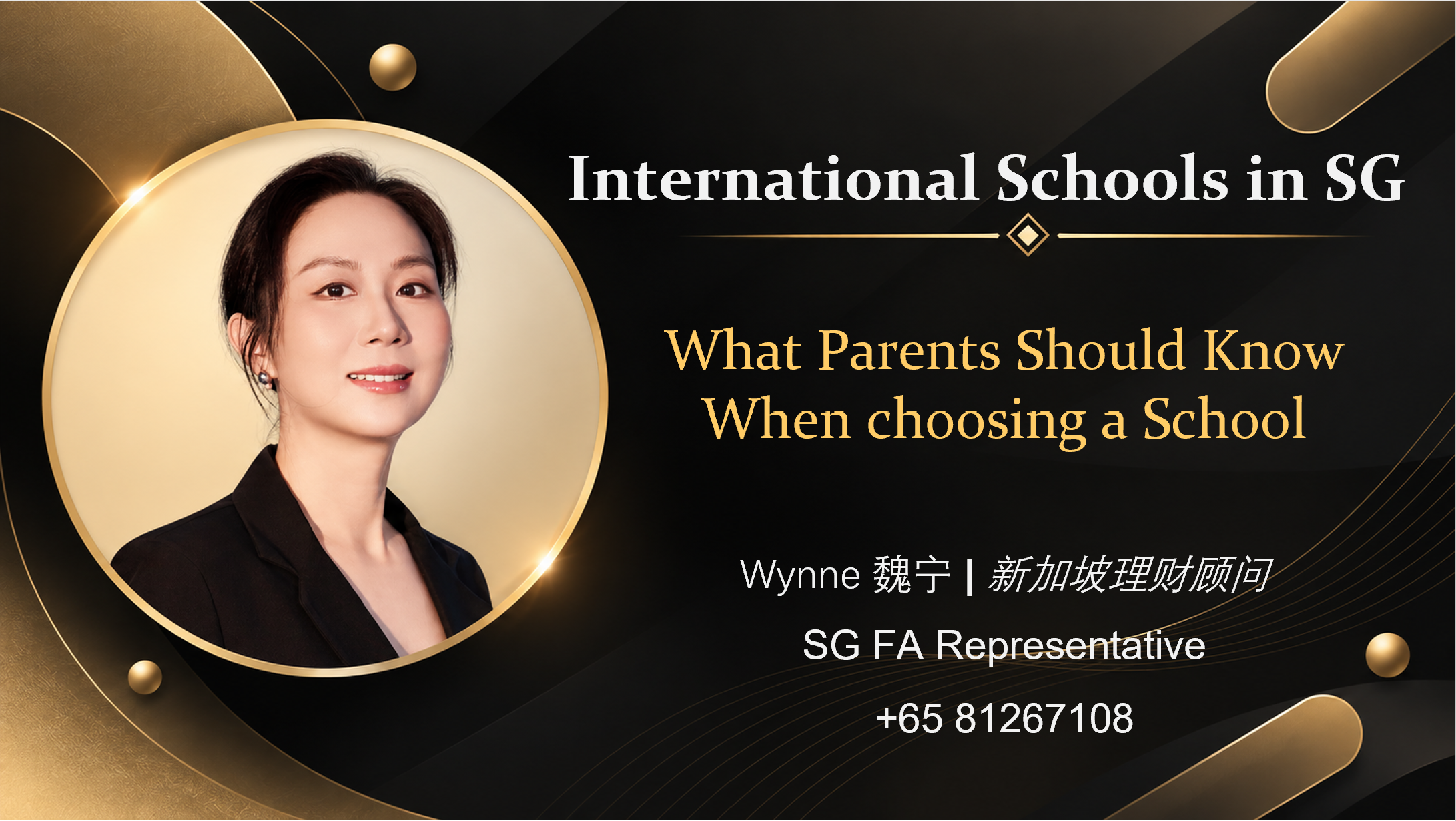
Choosing an International School in Singapore: What Parents Should Know
For many families in Singapore, education is more than a choice of school. It is a long-term decision that can influence a child’s development, future university options and the family’s financial planning.
Singapore has a wide range of international schools offering different curricula, including International Baccalaureate (IB), British, American and Australian programmes.
Understanding the Main Education Pathways
IB Curriculum
The IB framework focuses on inquiry, critical thinking, communication and a global perspective. It is widely recognized by universities around the world and is often considered by families seeking an internationally transferable education.
British Curriculum
British international schools commonly offer programmes such as IGCSE, followed by A-Levels or IB Diploma at senior levels. This pathway may suit families who prefer a structured academic curriculum with established examination stages.
American Curriculum
The American system generally offers a broader range of subjects and extracurricular opportunities, with pathways such as AP and IB available at some schools. It can provide flexibility for students with different academic interests.
Australian Curriculum
Australian international schools typically emphasise a broad-based education and may offer pathways including the Australian curriculum, IGCSE and IB, depending on the school.
Why Do Families Consider International Schools?
The appeal is often not simply about academic results.
International schools can provide:
- A multicultural learning environment
- English as a primary language of instruction
- Exposure to different cultures and perspectives
- Multiple pathways to universities overseas
- Greater flexibility for internationally mobile families
However, there is no single curriculum that is right for every child. The right choice depends on the child’s learning style, future education plans and the family’s long-term circumstances.
Education Choice Is Also a Financial Decision
International education can represent a significant long-term commitment. Beyond tuition fees, families may need to consider registration fees, transportation, activities, uniforms and other school-related expenses.
More importantly, education costs can continue for many years.
This is why international school planning should be considered alongside family wealth planning.
A well-structured education plan should answer three questions:
Where might our child study in the future?
Which education pathway is most suitable?
How much capital should the family prepare over the long term?
The objective is not simply to choose an expensive school.
It is to ensure that when an important educational opportunity arises, financial considerations do not unnecessarily limit the choices available to the next generation.
Education planning, therefore, is not just about paying school fees.
It is about creating options for the next generation.
Important: The information and opinions in this article are for general information purposes only. They should not be relied on as professional financial advice. Readers should seek unbiased financial advice that is customised to their specific financial objectives, situations & needs. This advertisement or publication has not been reviewed by the Monetary Authority of Singapore.

Published By:
Wynne Wei Ning
我是魏宁,2008年通过全额奖学金来到新加坡,并在本地公立医院手术室工作近14年。
如今作为理财顾问,我将医疗背景与金融专业相结合,为客户提供以需求为核心的保障与财富规划。
专业、责任、以客户为中心,陪伴客户做好每一步长期规划。如果您希望进一步与我联系,点击“预约咨询”。
I’m Wynne, I came to Singapore in 2008 on a full scholarship and spent nearly 14 years working in the operating theatre of a local public hospital.
Today, as a Financial Consultant, I combine my healthcare background with financial expertise to provide client-focused protection and wealth planning.
Professional. Responsible. Client-focused. Committed to every step of your long-term journey.
WA:+6581267108
WeChat:wynne_weining

CONTACT US
- 150 Beach Road #12-01/08, Gateway West Singapore 189720
- +65 62221889
- +65 62221019
- feedback@fa.com.sg